CameraGoogle Pixel 9 Pro XLƒƒ/1.7Shutter1/720 sFocal6.9 mmISO22DateFebruary 2026
Tallinn
Refracted urban landscape
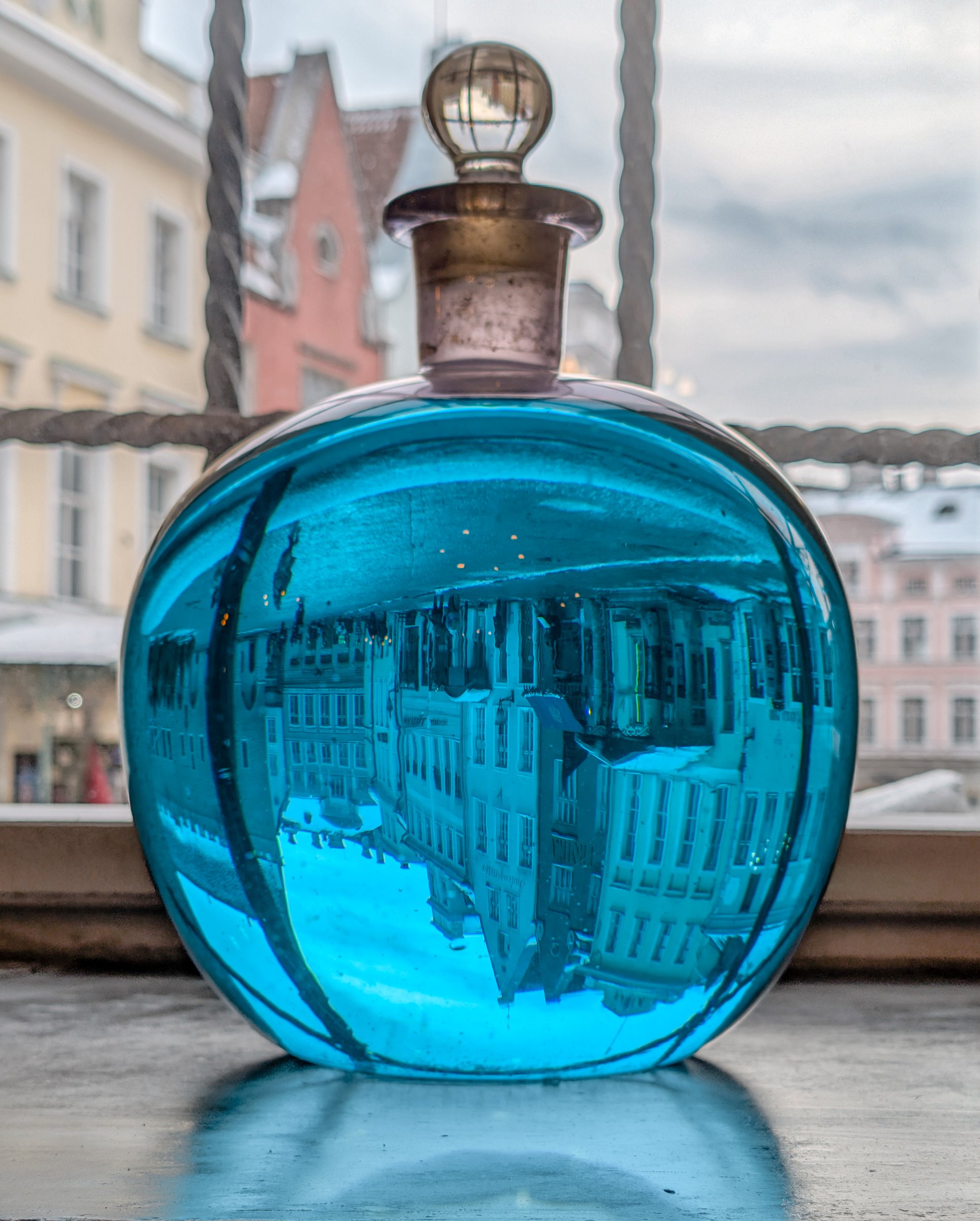
A spherical glass vessel filled with cobalt-blue liquid creates a compressed, inverted view of Tallinn's medieval Old Town architecture. Positioned at Raeapteek (Town Hall Pharmacy) in the historic district, the sphere captures the surrounding 15th and 16th-century merchant buildings and the town's characteristic roofline in miniature form. The optical distortion produced by the curved glass demonstrates principles of refraction and perspective, transforming the familiar urban geometry into an abstracted composition. The contrast between the saturated blue medium and the muted tones of the historical architecture creates a visual study in color and scale. Shot from ground level, the image frames the sphere against overcast Baltic skies and the rope railings of the pharmacy's window display, documenting both the artifact and its immediate architectural context.
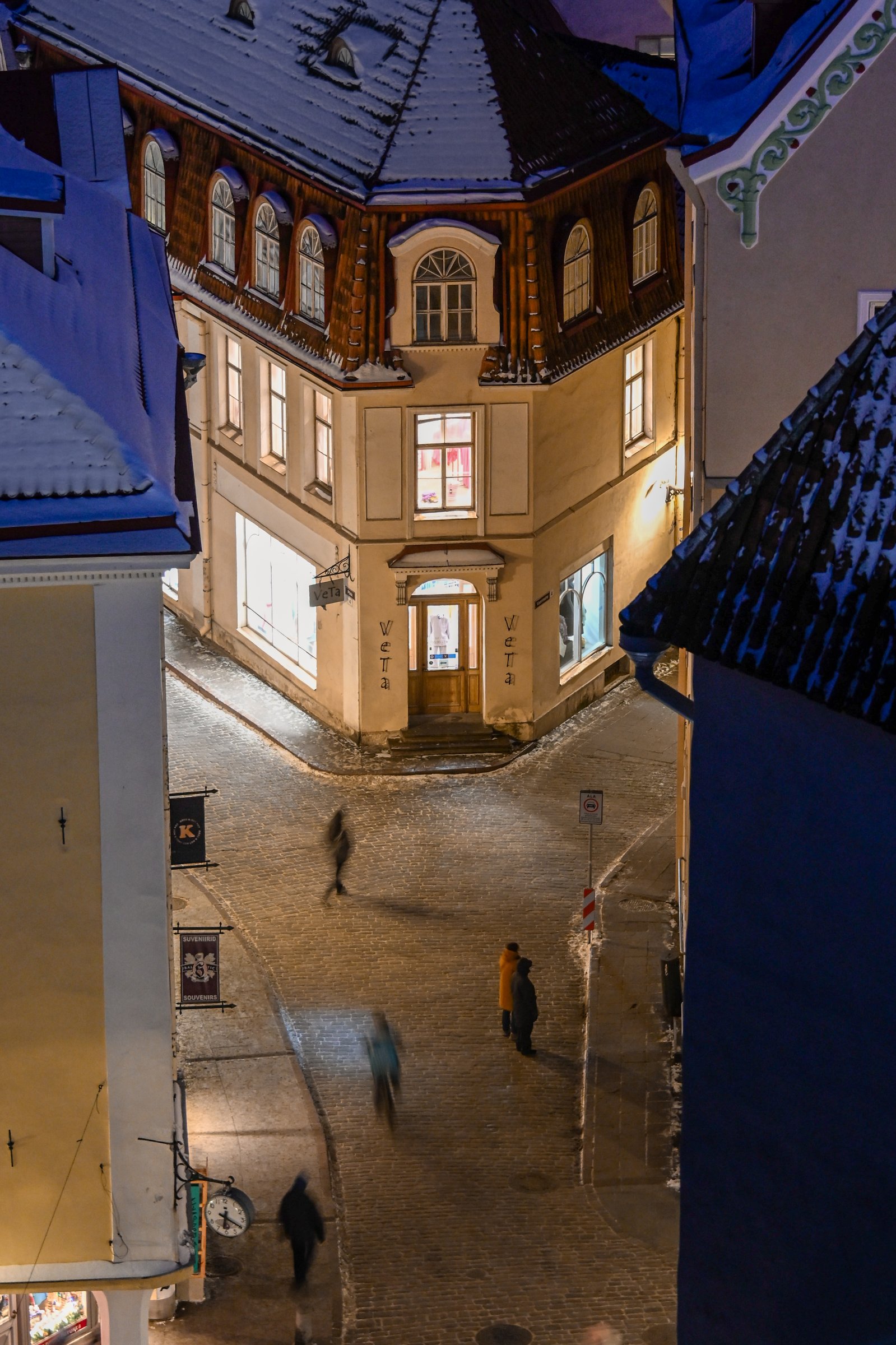
An elevated perspective captures a narrow European alleyway during twilight hours, revealing the layered architecture of a historic town center. The composition centers on a distinctive corner building with ochre-colored facades and a mansard roof punctuated by dormer windows, flanked by structures with contrasting blue-tiled roofs. Warm artificial lighting illuminates the architectural details of the central edifice, while cooler ambient light defines the surrounding streetscape. Multiple pedestrians traverse the brick-paved alley, their motion captured as blurred figures against the stationary urban geometry. The image documents the interplay between human movement and static architectural form, capturing a moment of everyday activity within a preserved historical district. The vertical framing emphasizes the spatial compression characteristic of medieval town planning, where buildings define narrow corridors of public space.
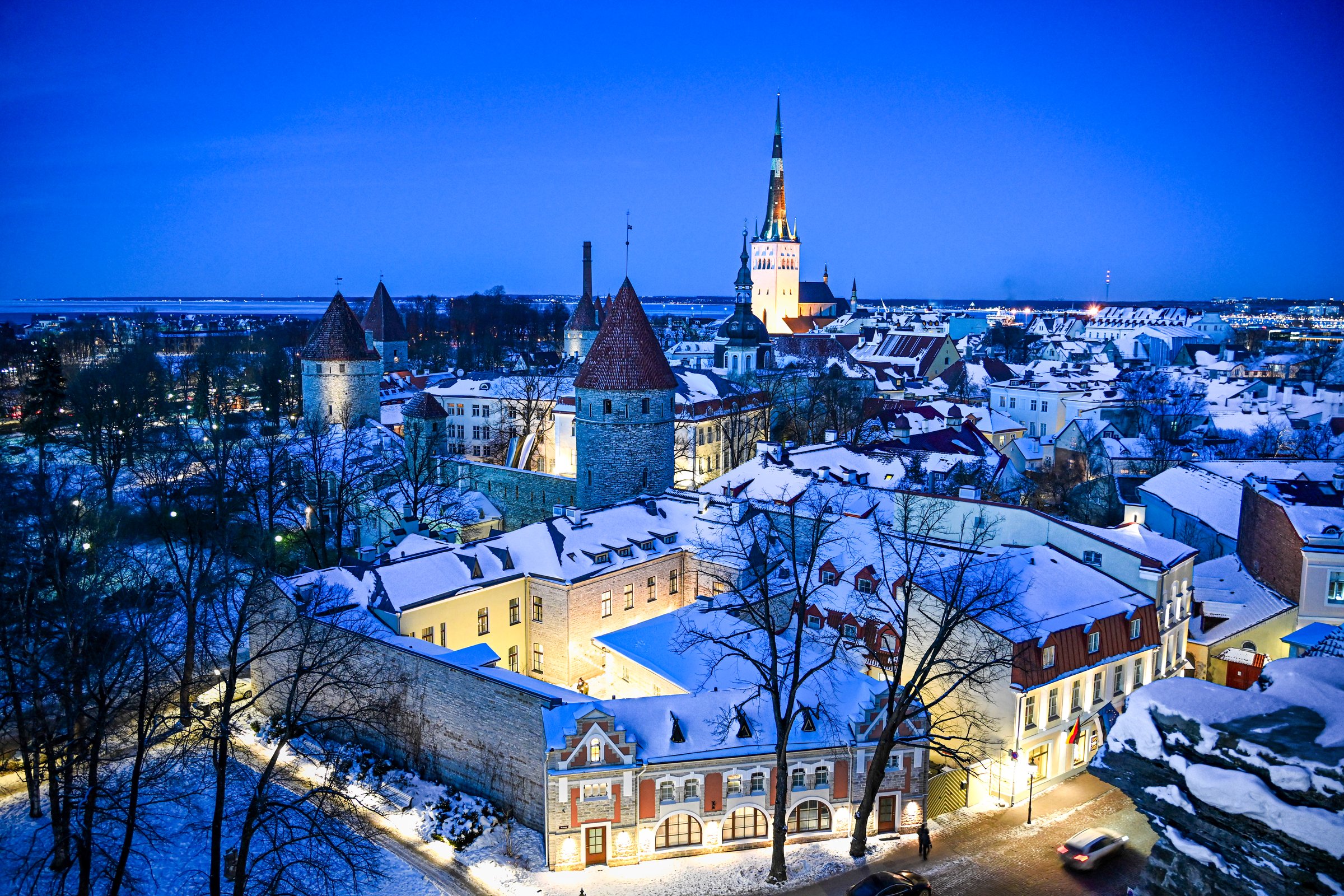
This elevated view captures Estonia's capital during the twilight hours of winter, revealing the medieval architecture that defines Tallinn's UNESCO World Heritage Old Town. The photograph documents the city's distinctive silhouette, dominated by the spire of Alexander Nevsky Cathedral and surrounded by defensive towers dating to the 13th and 14th centuries. Fresh snow blankets the terracotta and slate roofs of residential buildings, while selective artificial lighting illuminates key structures below. The frozen landscape extends toward the distant coastline and frozen waters of the Gulf of Finland, visible along the horizon. The image exemplifies how Northern European cities maintain their historical urban cores while adapting to seasonal environmental conditions. The contrast between the illuminated foreground architecture and the deep twilight sky captures the brief daylight hours characteristic of Baltic winter months, typically occurring between 16:00 and 17:00 during late February.
This elevated view captures the defensive tower complex of Tallinn's Old Town wall system, a 14th-century fortification that remains one of Northern Europe's best-preserved medieval structures. The distinctive red-tiled conical roofs crown the limestone towers, characteristic of Baltic defensive architecture. Snow blankets the courtyard and surrounding rooftops, while bare deciduous trees frame the composition against the winter landscape. Modern residential buildings integrate seamlessly with the historic fortifications, illustrating how this UNESCO World Heritage site continues to function as a living urban center. The clear atmospheric conditions reveal the extent of the wall system stretching across the cityscape, demonstrating the scale of medieval engineering required to protect this strategic Baltic trading port.
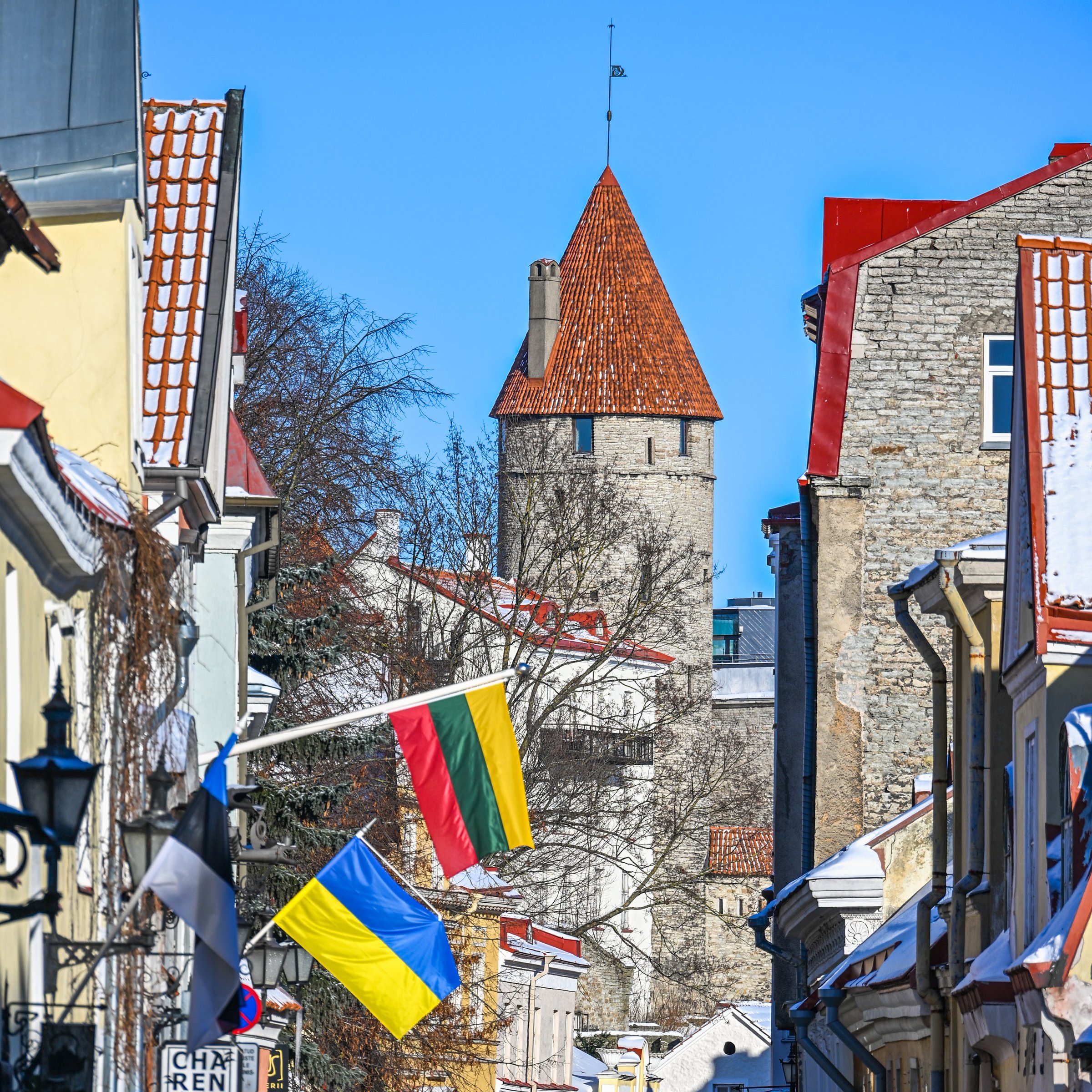
A 14th-century defensive tower rises above the narrow streets of Tallinn's historic district, its distinctive red-tiled conical roof dominating the urban skyline. The structure, part of the city's medieval fortification system, stands surrounded by period architecture featuring characteristic terracotta roof tiles and stone masonry. Regional flags—including the Estonian and Ukrainian colors—hang from the surrounding buildings, reflecting the area's contemporary cultural significance. The tower's strategic positioning at the intersection of multiple streets demonstrates the urban planning principles of medieval Baltic trade centers, where such structures served both defensive and administrative functions. Clear atmospheric conditions and the sparse winter vegetation reveal the architectural details of the surrounding residential and commercial buildings that have been preserved within the old town's protected zone.
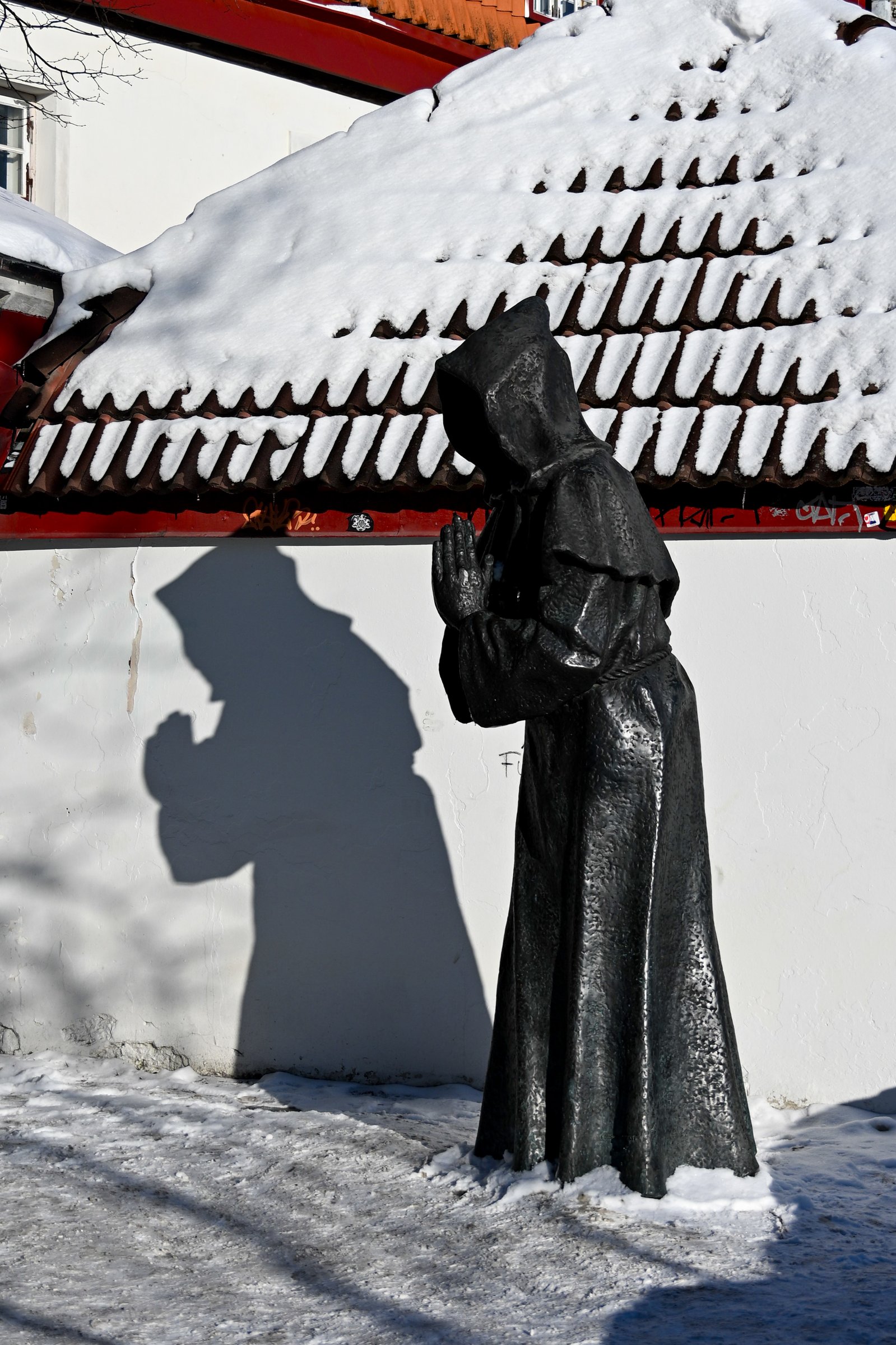
A bronze sculpture stands in Tallinn's medieval Old Town as winter recedes, its dark form anchoring a courtyard framed by traditional Estonian architecture. Snow clings to the steeply pitched roof and decorative tilework behind, while the figure's cast shadow doubles its presence on the whitewashed wall. The image documents the seasonal transition in the Baltic capital, where public monuments persist through cycles of freeze and thaw, their surfaces recording the passage of time and climate across the region's historic districts.
A windowsill in Tallinn, Estonia displays a poignant collection of weathered books arranged as a makeshift memorial, their spines facing outward like sentinels. Blue and white Estonian flags—the national colors—stand among the volumes, flanked by dried heather and warm string lights that pierce the winter darkness. The books, many bearing Cyrillic and Latin scripts, represent works spanning multiple languages and cultures, their aged covers testament to years of reading and handling. This spontaneous installation captures a moment of collective remembrance, where literature serves as a vessel for cultural identity and shared grief. The juxtaposition of preserved knowledge against the elements—visible dust and weathering on the window glass—underscores the fragility of memory and the enduring power of the written word in times of upheaval.
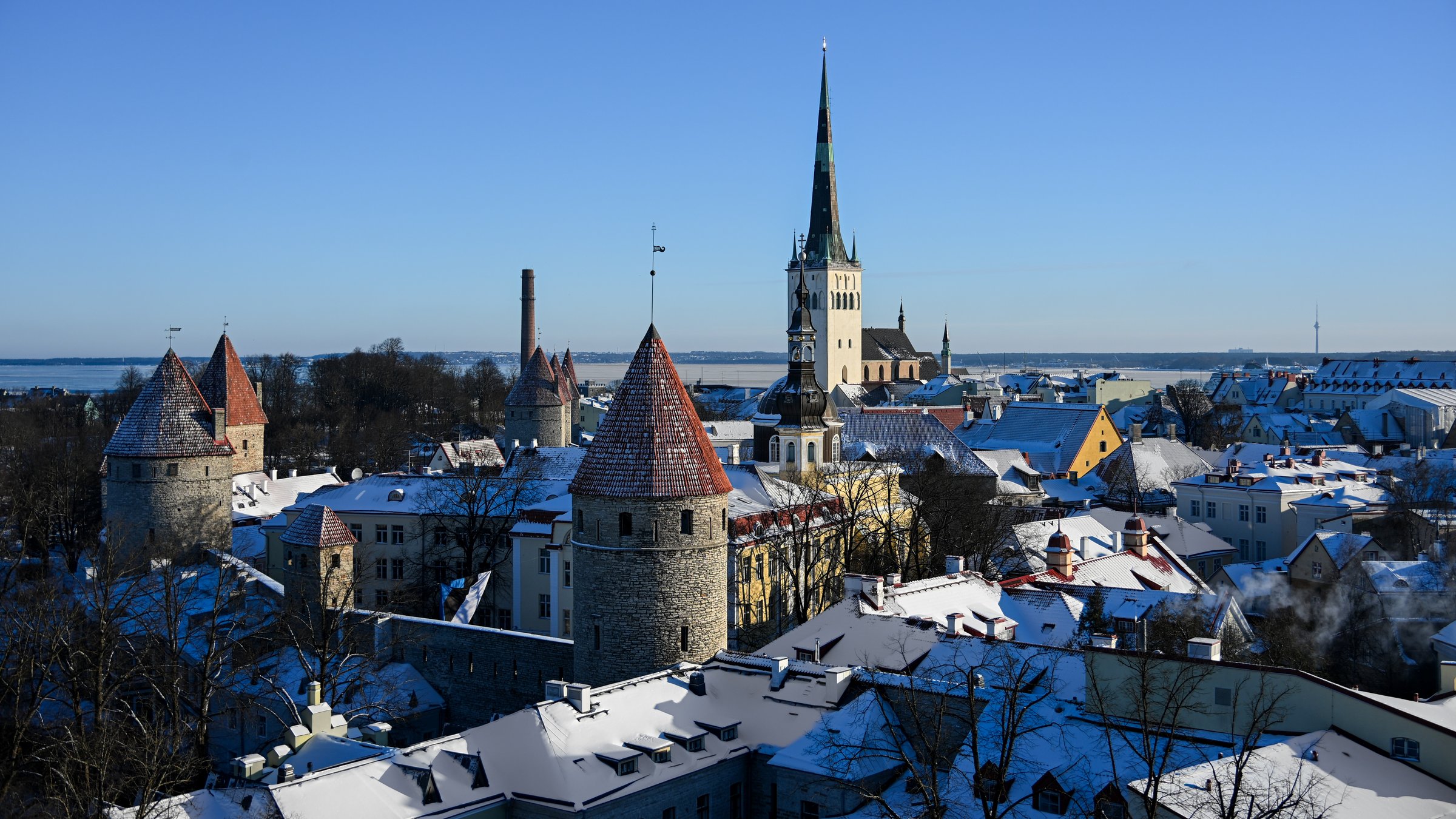
This elevated view captures the Old Town of Tallinn, Estonia, during winter conditions. The composition reveals the city's layered urban history, with medieval defensive towers and church spires dominating the skyline against the frozen expanse of the Baltic Sea. The prominent St. Olaf Church, identifiable by its distinctive tall spire, rises above the surrounding architecture—a structure that has served as a navigational landmark for Baltic seafarers since the 13th century. The snow-covered roofscape demonstrates the architectural diversity of the Old Town, ranging from preserved medieval stone fortifications to 19th-century residential buildings. The frozen bay visible in the background underscores the region's seasonal climate patterns and historical significance as a major Baltic trading port. The bare deciduous trees scattered throughout the composition indicate the depth of winter, while the clear atmospheric conditions provide optimal visibility of the urban landscape's structural elements and spatial relationships. This image documents a UNESCO World Heritage site that represents centuries of Northern European cultural and commercial development.
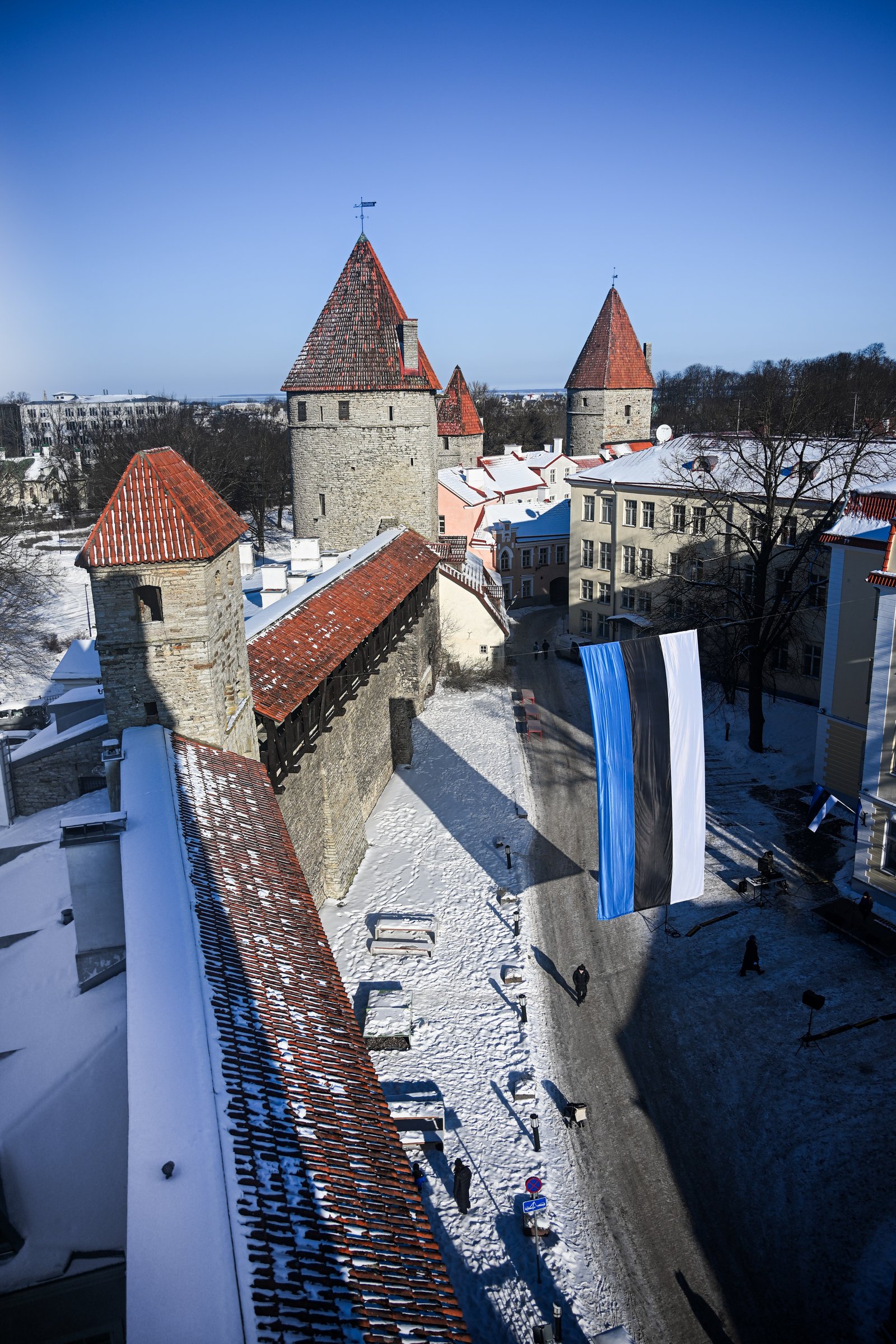
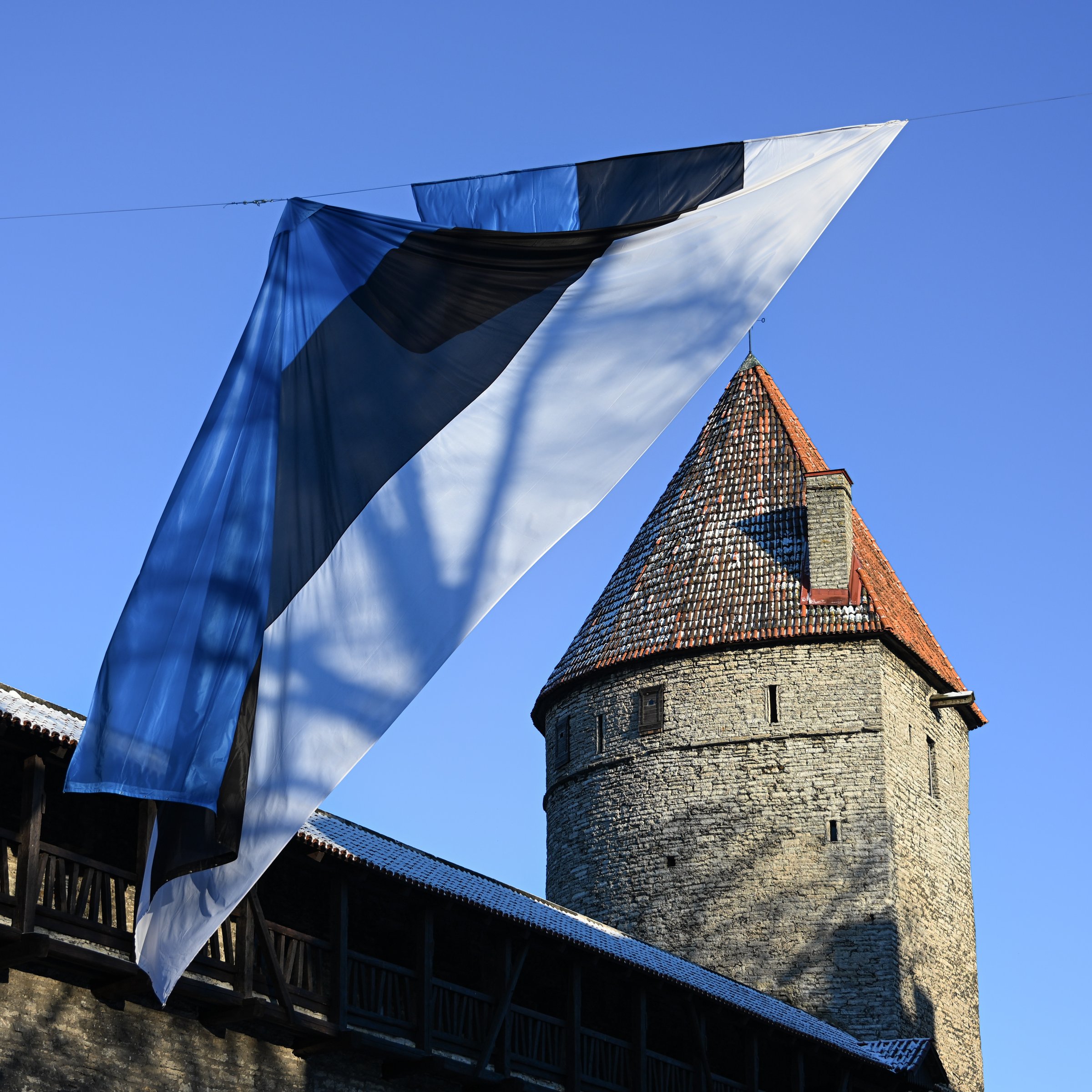
The Nun Tower, or Nunnadekaik, stands as one of Tallinn's best-preserved medieval defensive structures, its cylindrical stone base and conical roof dating to the 14th century. Originally part of the city's fortification system, the tower once served as both a defensive position and a prison. Today, the Estonian flag—its blue, black, and white tricolor billowing in the wind—frames the historic structure against a clear sky, creating a visual dialogue between Estonia's medieval past and its modern national identity. The tower's weathered limestone walls and terracotta roof tiles bear witness to centuries of Baltic history, while the adjacent wooden structures reflect the traditional architecture characteristic of Tallinn's UNESCO World Heritage Old Town. The interplay of shadow and fabric across the stone surface captures a moment of contemporary life intersecting with centuries-old heritage.
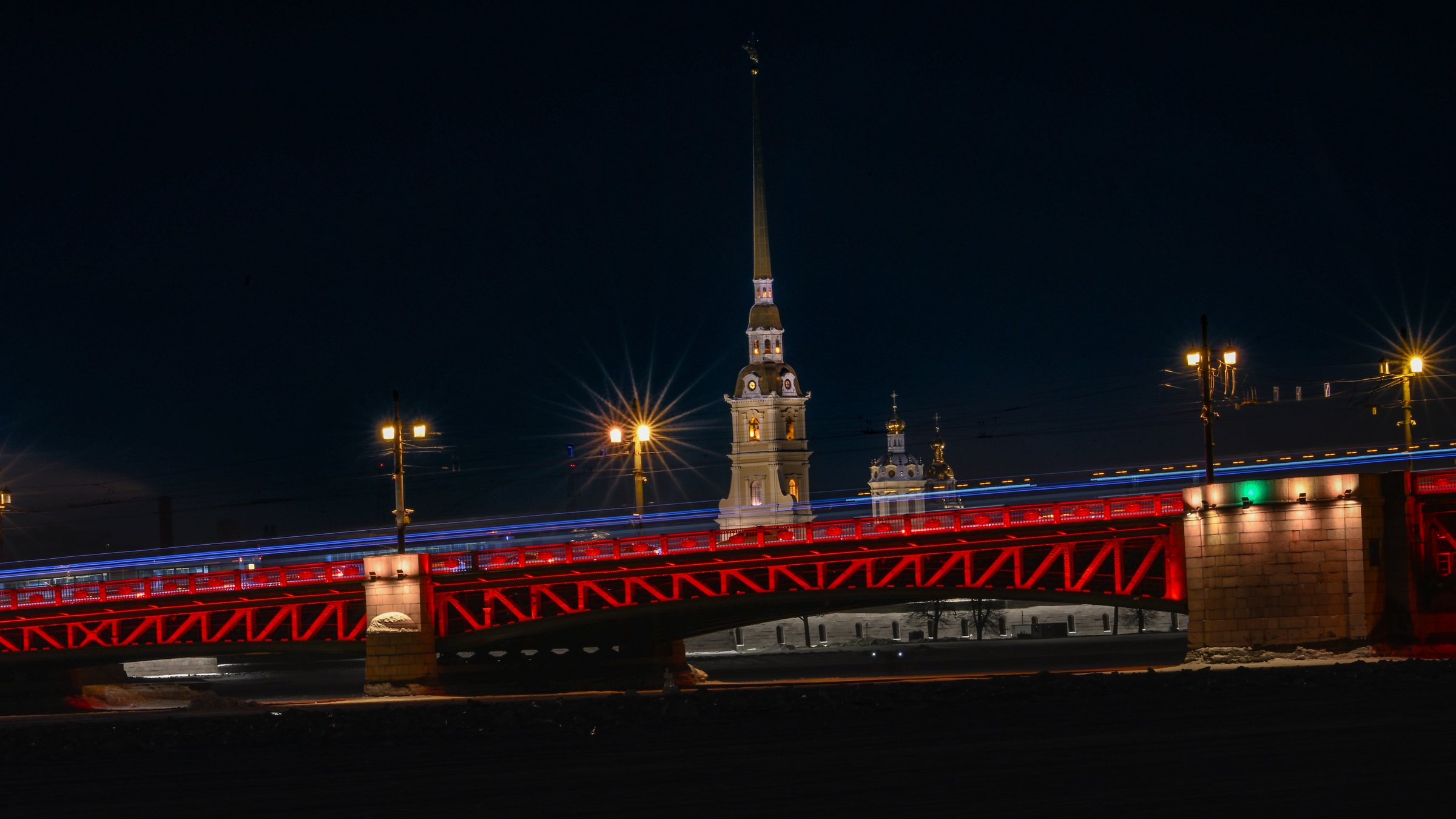
The Palace Bridge in Saint Petersburg glows in ceremonial red, its steel lattice structure illuminated for Chinese New Year celebrations. A long-exposure photograph captures a bus traversing the span, its light trail streaking across the frame as a temporal marker of urban movement. The Peter and Paul Fortress cathedral rises beyond, its gilded spire maintaining its permanent luminescence against the night sky. The extended shutter speed transforms the transient vehicle into a continuous line of light, creating a visual record of the bridge's dual function: both static architectural monument and active conduit for city traffic. The deliberate color choice—red pigmentation applied specifically for the holiday period—documents a temporary transformation of this 19th-century engineering structure, illustrating how historical landmarks adapt to contemporary cultural observances. Water reflections amplify the chromatic intensity, while the contrast between the bridge's warm tones and the cool night atmosphere emphasizes the interplay between artificial illumination and natural darkness in urban environments.
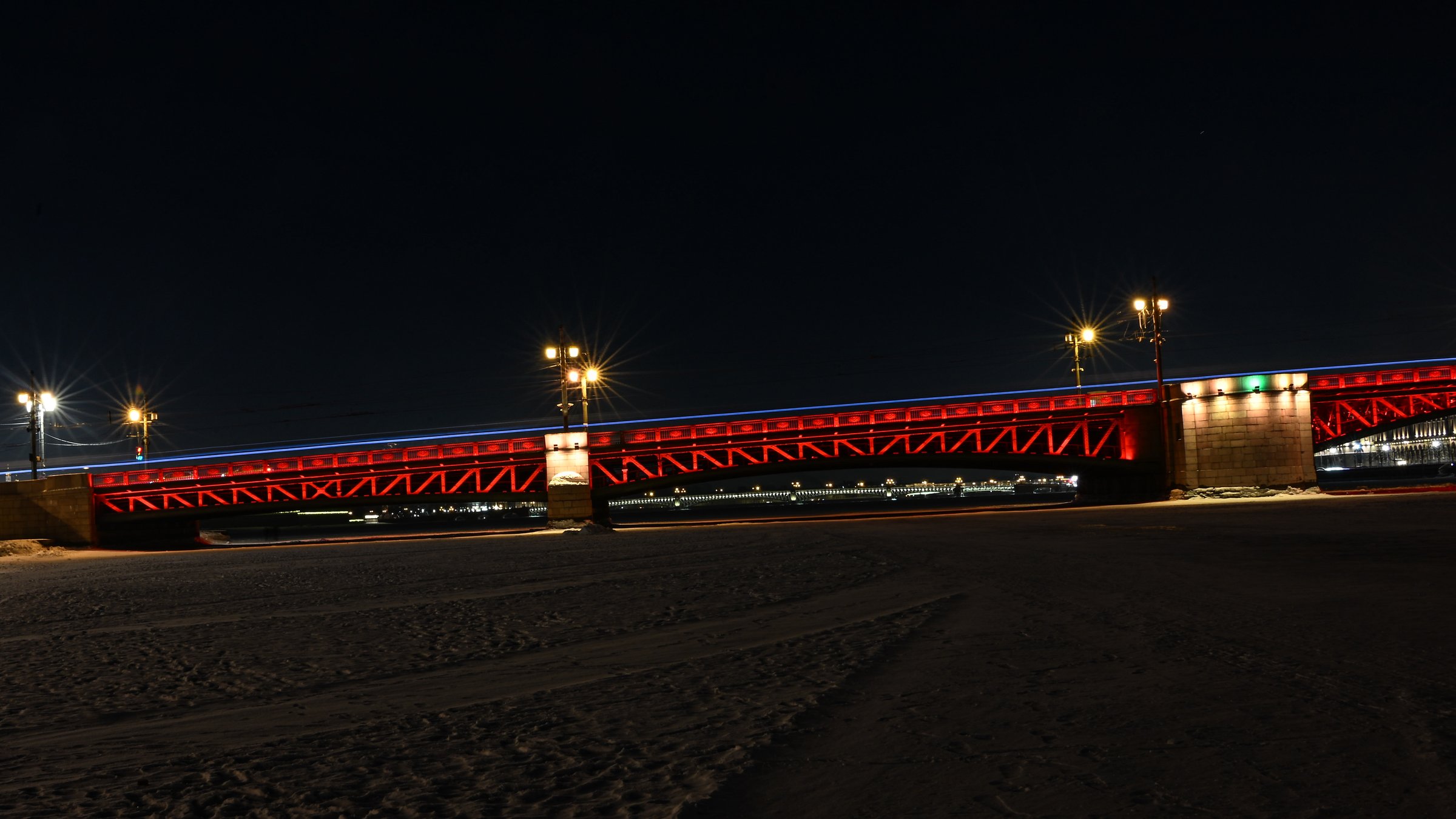
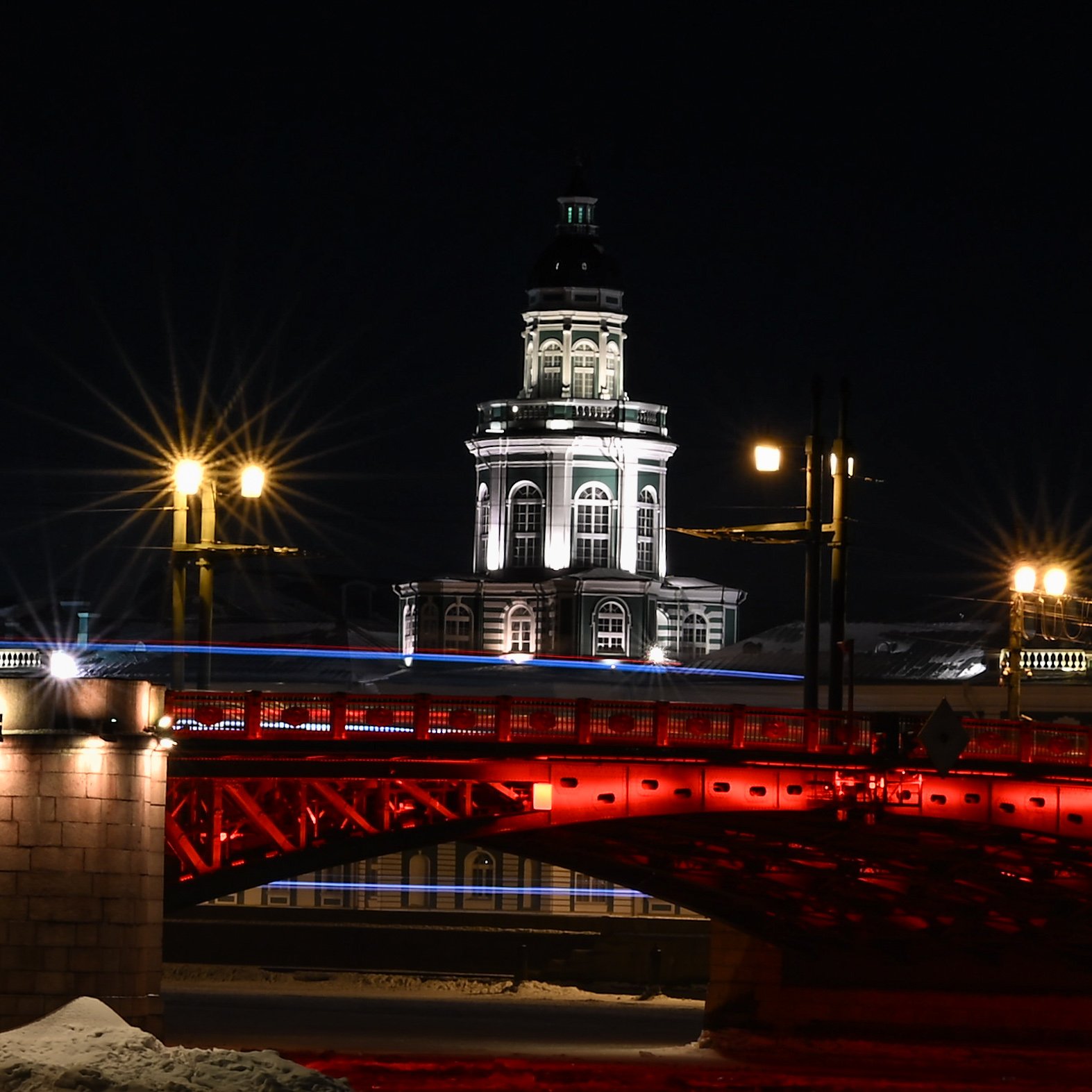
Palace Bridge during Chinese new year celebrations
A long-exposure photograph captures the Palace Bridge in St. Petersburg illuminated in red—a temporary installation marking Chinese New Year festivities. The extended shutter speed renders a passing bus as a ghosted form traversing the iconic cast-iron structure, creating a temporal record of urban movement against the stationary architecture. The bridge's distinctive red lattice work, typically painted in its characteristic hue, is here emphasized through festival lighting that extends the visual narrative of the crossing. Taken during night hours, the composition documents the intersection of historical infrastructure and contemporary cultural observance, with the Neva River's embankment visible in the foreground and the bridge's ornamental street lamps providing reference points in the darkness.
A long-exposure photograph captures the Palace Bridge in Saint Petersburg bathed in ceremonial red lighting during Chinese New Year celebrations. The Kunstkamera, an 18th-century Baroque structure housing Russia's first museum, rises prominently in the background, its neoclassical tower illuminated against the night sky. The bridge's distinctive red glow—a temporary installation marking the lunar festival—creates a striking contrast with the warm amber streetlights and the cool blue accent lighting visible along the span. The extended exposure time renders a passing bus as a ghostly trace of light across the bridge's surface, documenting the continuous flow of urban traffic through one of Saint Petersburg's most historically significant landmarks. The composition juxtaposes the city's architectural heritage with contemporary ceremonial lighting, reflecting the intersection of Russian and global cultural observances in the urban landscape.
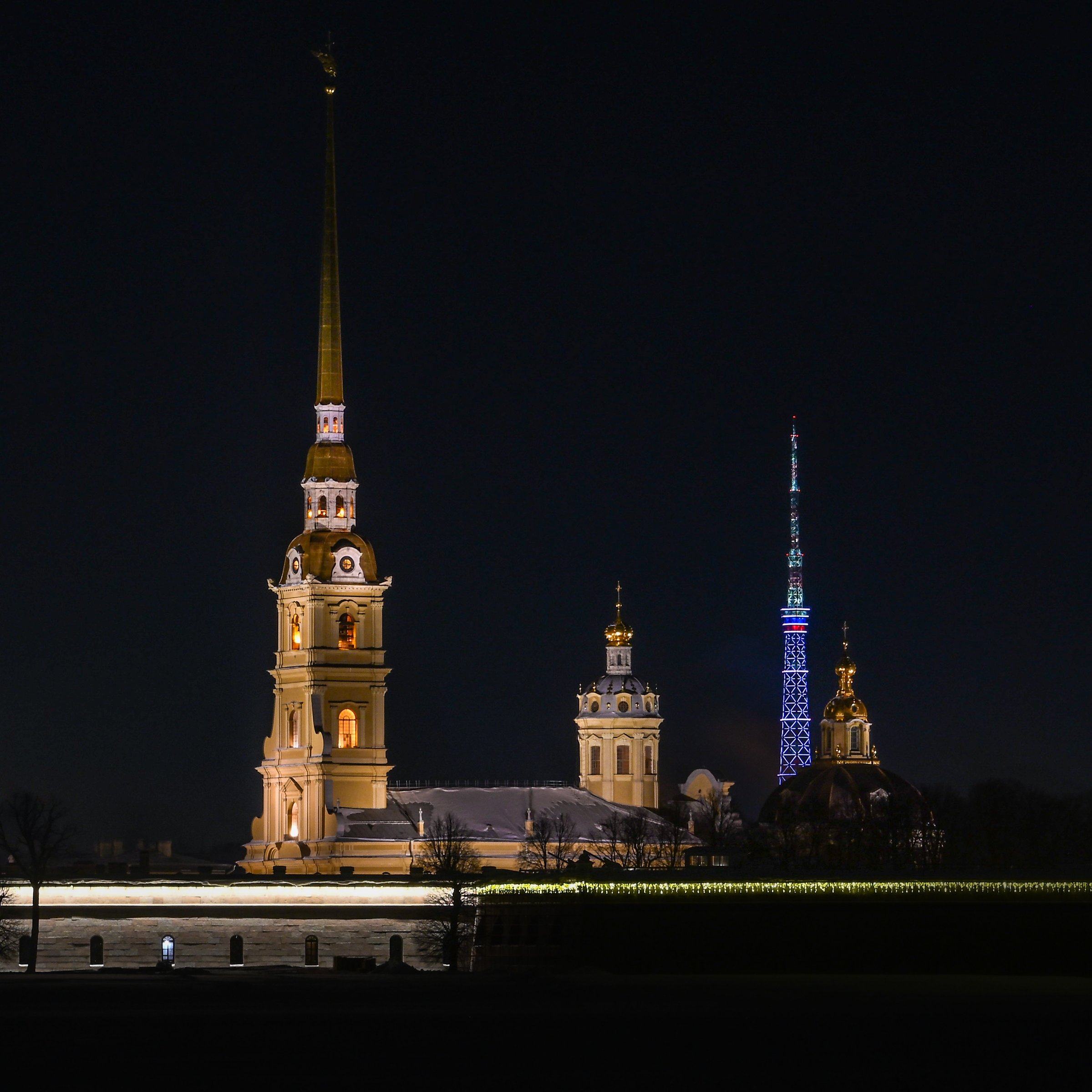
The illuminated spires of St. Petersburg's religious landmarks pierce the winter darkness across the Neva River. The Peter and Paul Cathedral's distinctive tall bell tower dominates the left frame, its neoclassical proportions accentuated by warm accent lighting. The frozen riverbank in the foreground and strategic nighttime illumination reveal the geometric precision of the structures' design, while the stark contrast between the lit monuments and the black sky emphasizes their prominence within the urban landscape. This nocturnal view documents how St. Petersburg's historical religious architecture remains a defining feature of the city's contemporary identity.
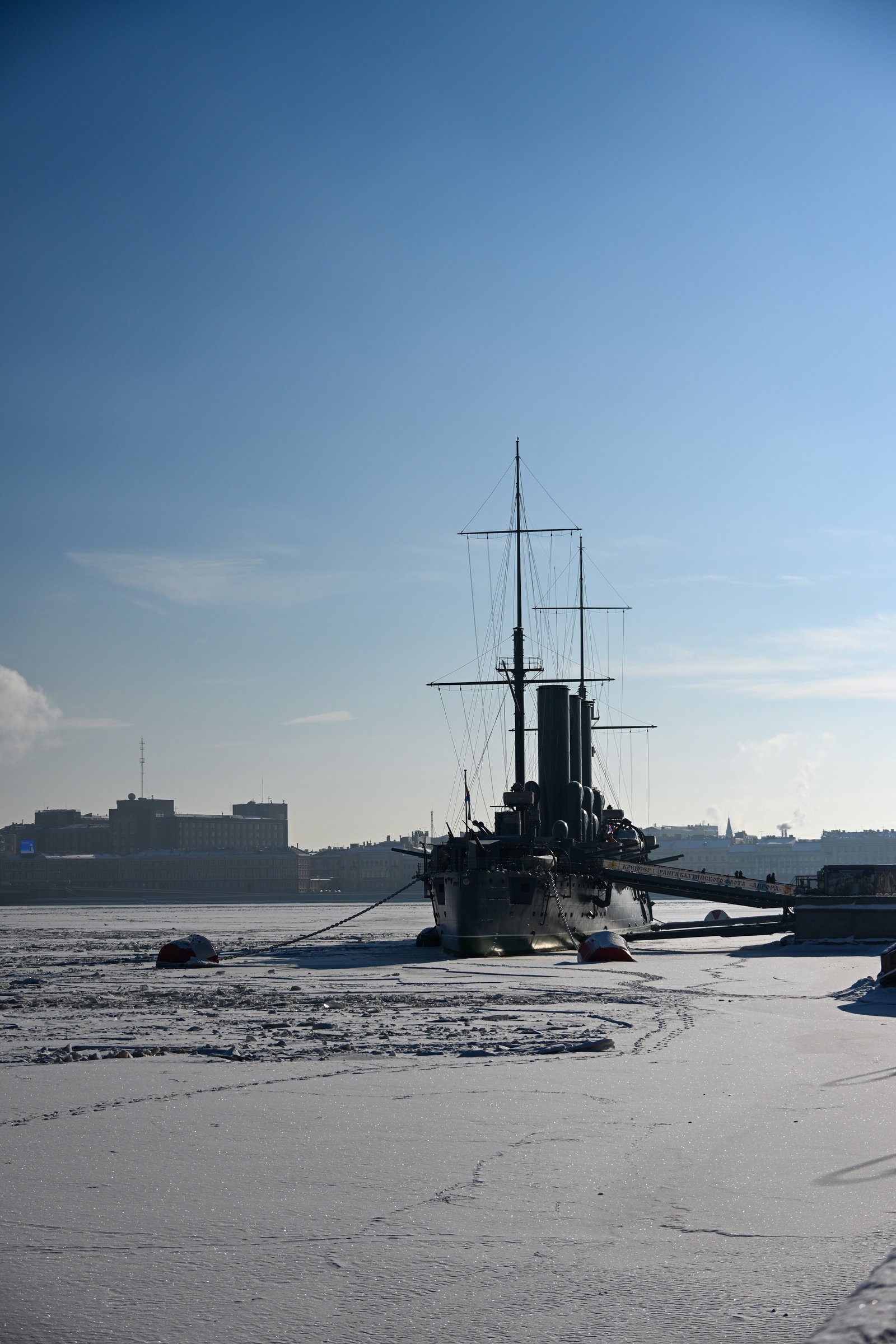
The Aurora Cruiser, a steel-hulled icebreaker and expedition vessel, sits grounded on a tidal flat adjacent to a densely populated urban center. The ship's distinctive silhouette—characterized by its tall mast rigging, compact superstructure, and reinforced bow—reflects its design for polar and sub-polar navigation. Mooring lines secure the vessel to the sandy substrate as the surrounding waterway drains during low tide, exposing the intertidal zone. Modern apartment buildings and infrastructure visible across the water underscore the vessel's position at the intersection of maritime heritage and contemporary urban development. The photograph documents a moment of stillness in what is typically an active working vessel, capturing the scale and engineering of expedition-class ships designed to operate in extreme environments.
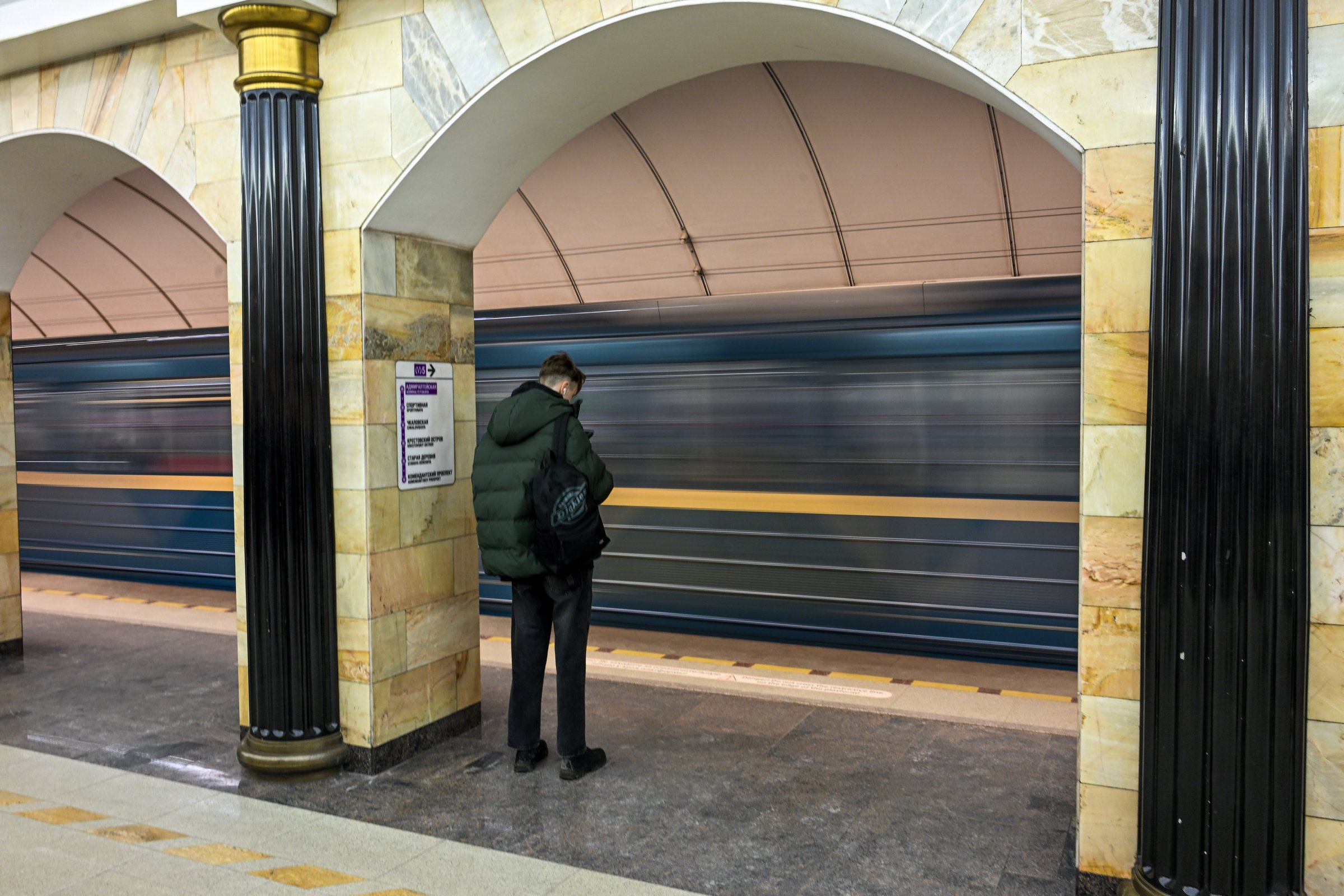
A solitary commuter waits on the platform of a St. Petersburg metro station, captured during a moment of transit. The image documents the neoclassical architecture characteristic of the city's Soviet-era underground railway system, featuring ornate columns with brass capitals, arched ceilings, and marble-clad walls in cream and ochre tones. A train with distinctive blue and orange livery sits stationary at the platform. The composition reveals the geometric precision of the station's design—symmetrical archways and linear elements create a sense of ordered space within the urban infrastructure. The photograph captures a routine moment of urban mobility in one of Europe's oldest metro systems, which remains a functional example of mid-20th century public transportation architecture.
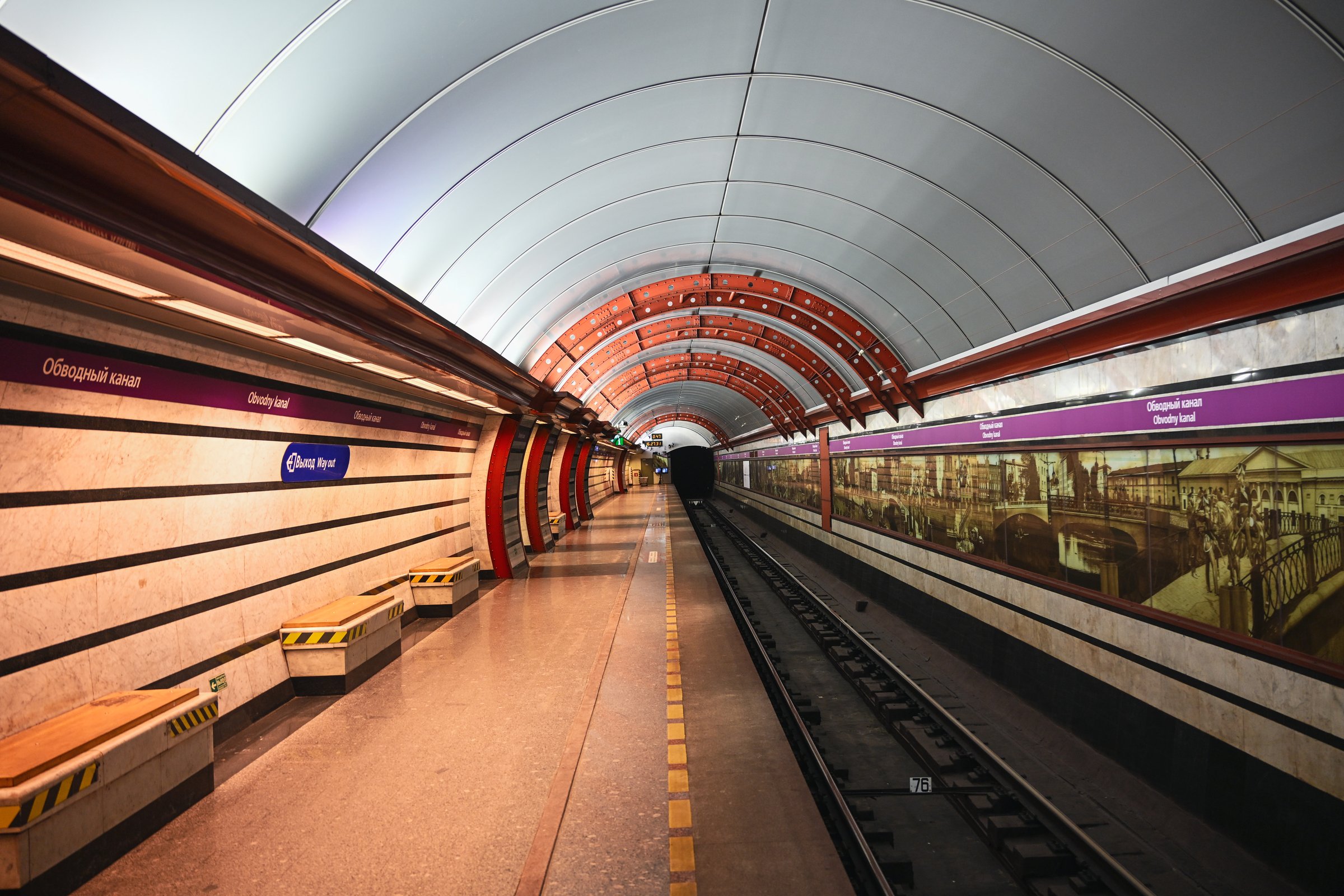
The Obvodny Kanal station on the Saint Petersburg Metro exemplifies Soviet-era underground architecture, featuring a distinctive barrel-vaulted tunnel design with concentric arched ribs. The station's defining characteristic is its warm terracotta and cream-colored palette, contrasted by deep red structural elements and purple signage bearing Cyrillic text. The composition reveals the geometric precision of the tunnel's construction, with a symmetrical perspective that extends toward a distant vanishing point. Yellow safety markings line the platform edge, while the station remains empty of passengers, capturing the infrastructure in its operational state. Opened in 1958, the station represents a significant example of mid-20th-century Russian metro design, serving as a transport hub connecting the Neva River district with central Saint Petersburg.
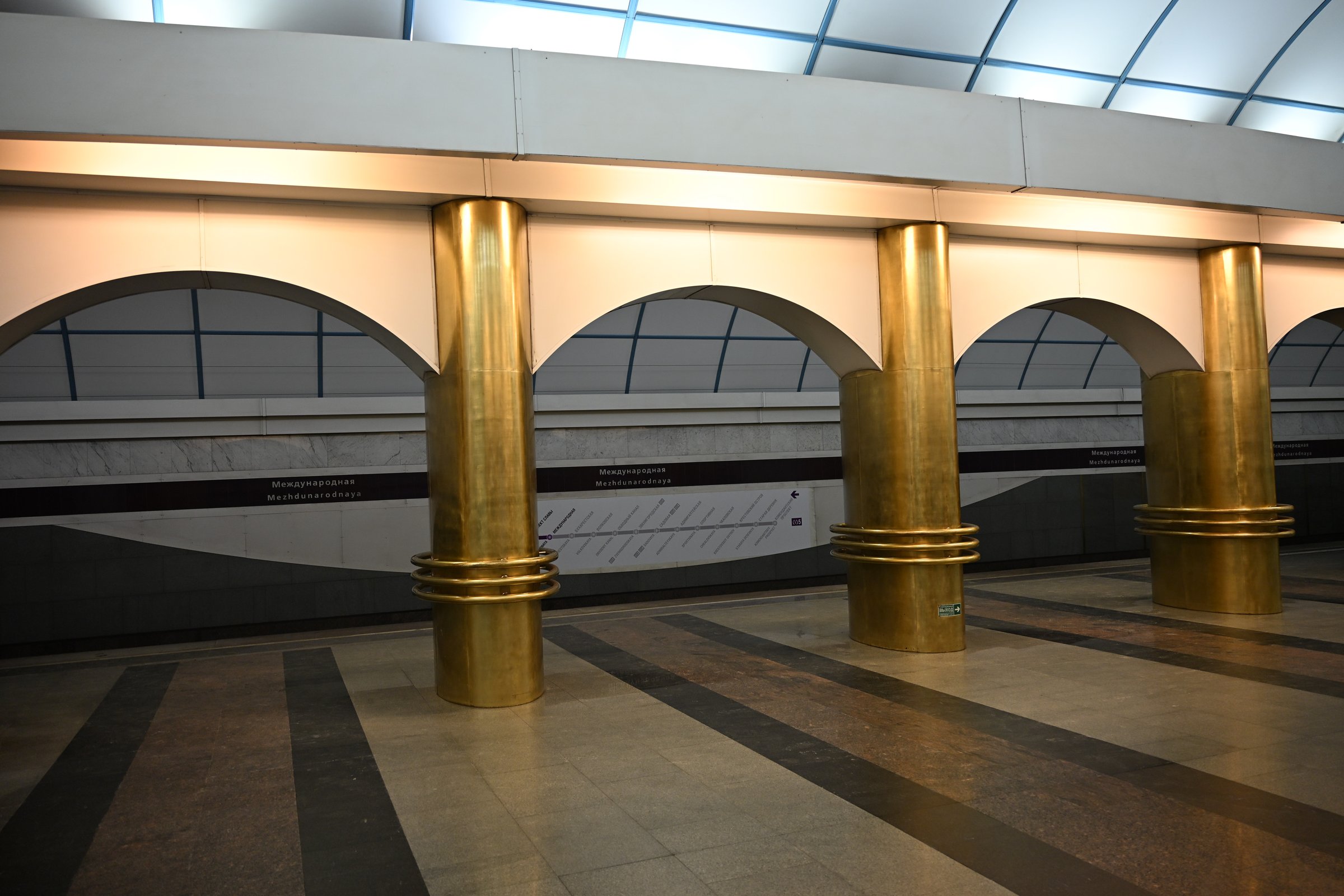
The Mezhdunarodnaya station platform in Saint Petersburg's metro system showcases the distinctive architectural vocabulary of the city's underground transit network. A series of gilded cylindrical columns punctuate the platform at regular intervals, their polished brass surfaces reflecting the overhead lighting. These structural supports frame a succession of arched openings that reveal the tunnel bore beyond, creating a rhythmic progression of geometric forms receding into depth. The station's ceiling integrates both solid panels and translucent sections fitted with linear lighting elements, establishing a controlled illumination scheme throughout the space. The platform floor is composed of alternating bands of stone in contrasting tones, establishing a linear visual pattern that guides movement through the station. Cyrillic text identifying the station name appears on the platform wall. The station functions as a key interchange point within Saint Petersburg's metro system, designed to facilitate the efficient flow of passenger traffic through this subterranean infrastructure. The deliberate material choices and spatial organization reflect mid-to-late 20th-century approaches to underground station design in major Soviet cities.
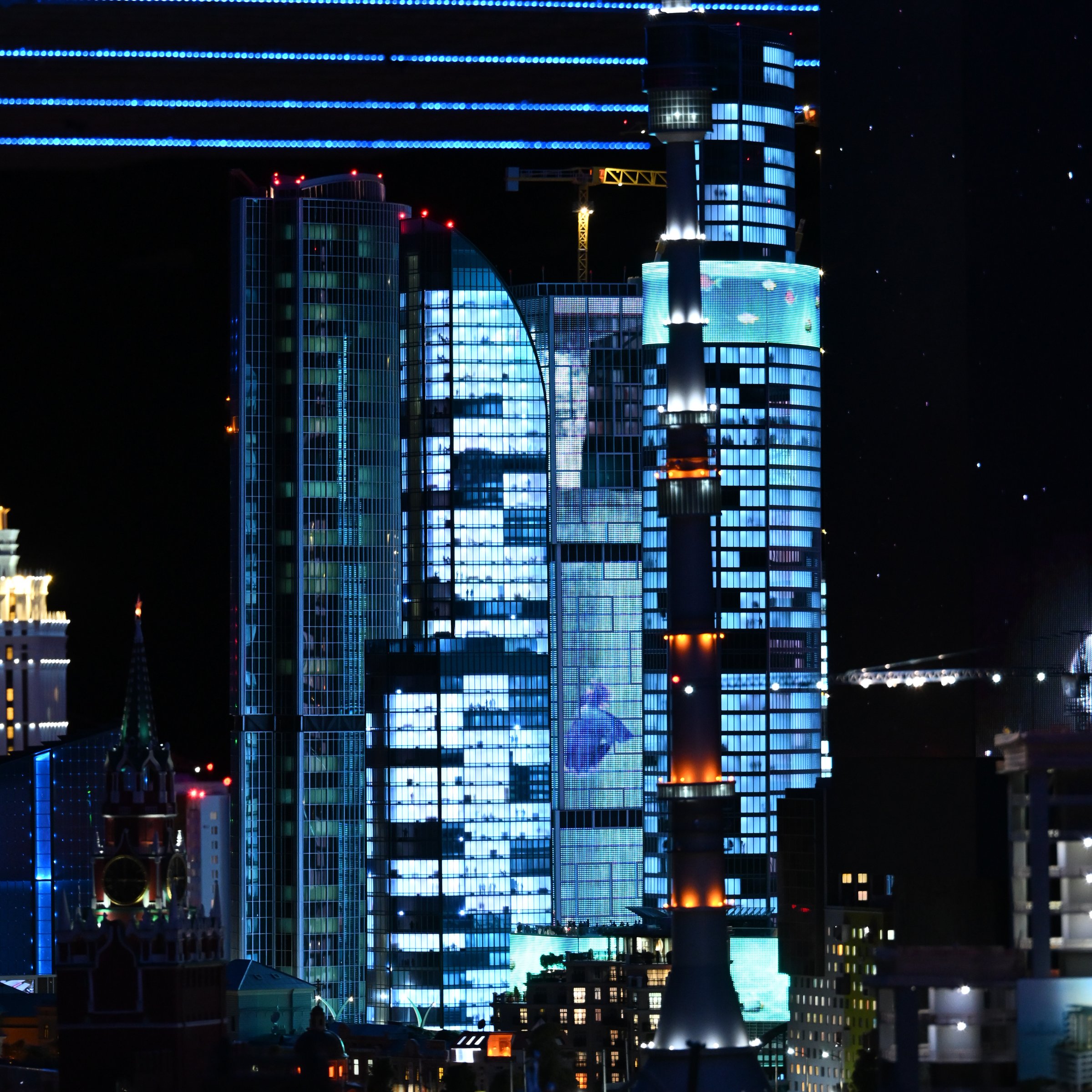
This photograph captures a meticulously detailed miniature representation of Moscow's illuminated skyline during evening hours. The diorama showcases contemporary high-rise architecture characteristic of Russia's capital, with particular emphasis on the International Business Center (Moscow City) complex. The model employs strategic LED lighting to simulate nocturnal urban conditions, with cool-toned blue and cyan illumination dominating the modern office towers, while warm amber and orange accent lights suggest street-level activity and architectural features. The composition reveals the technical precision required in architectural miniaturization—individual window units are distinctly rendered, and the layered depth of the cityscape creates a convincing sense of urban density. Overhead linear lighting elements suggest transportation infrastructure or urban design features. The contrast between illuminated structures and the dark background emphasizes the scale and three-dimensional complexity of the model. Grand Maket Russia, located in Saint Petersburg, functions as an extensive exhibition of Russian geography and urban centers rendered at 1:120 scale. This particular installation demonstrates how controlled lighting design can transform miniature landscapes into compelling studies of contemporary urban environments and their nocturnal character.
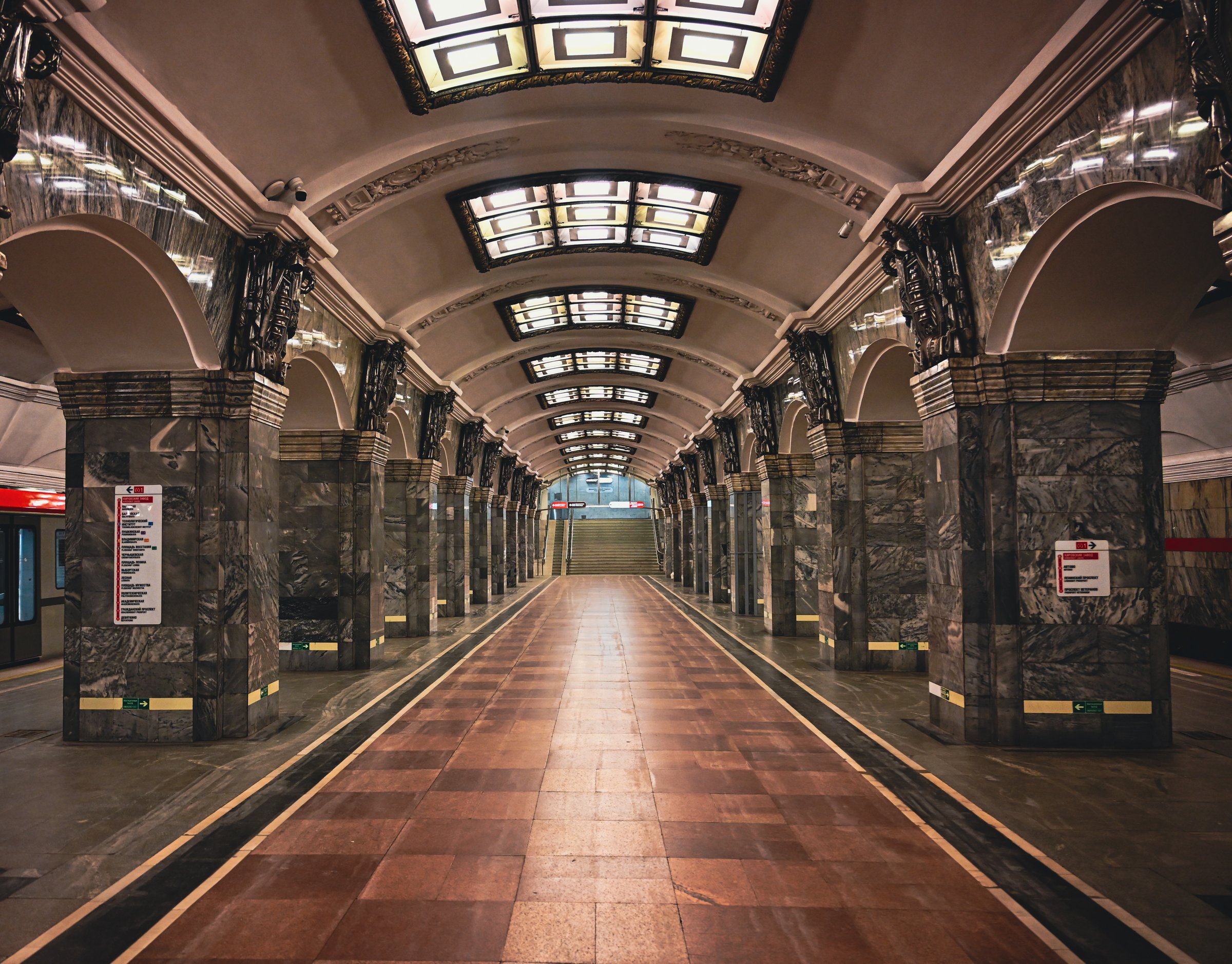
The Kirovskiy Zavod metro station exemplifies Soviet-era monumental architecture, featuring a symmetrical corridor lined with dark marble columns and ornamental relief panels. Constructed during the mid-20th century, the station reflects the ideological emphasis on public spaces as expressions of state achievement. The coffered ceiling with integrated lighting and the geometric floor pattern of contrasting tiles demonstrate the engineering precision characteristic of Leningrad's metro system. The station remains largely unchanged since its completion, preserving its original design intent while serving as a functional transit hub for the city's industrial district.
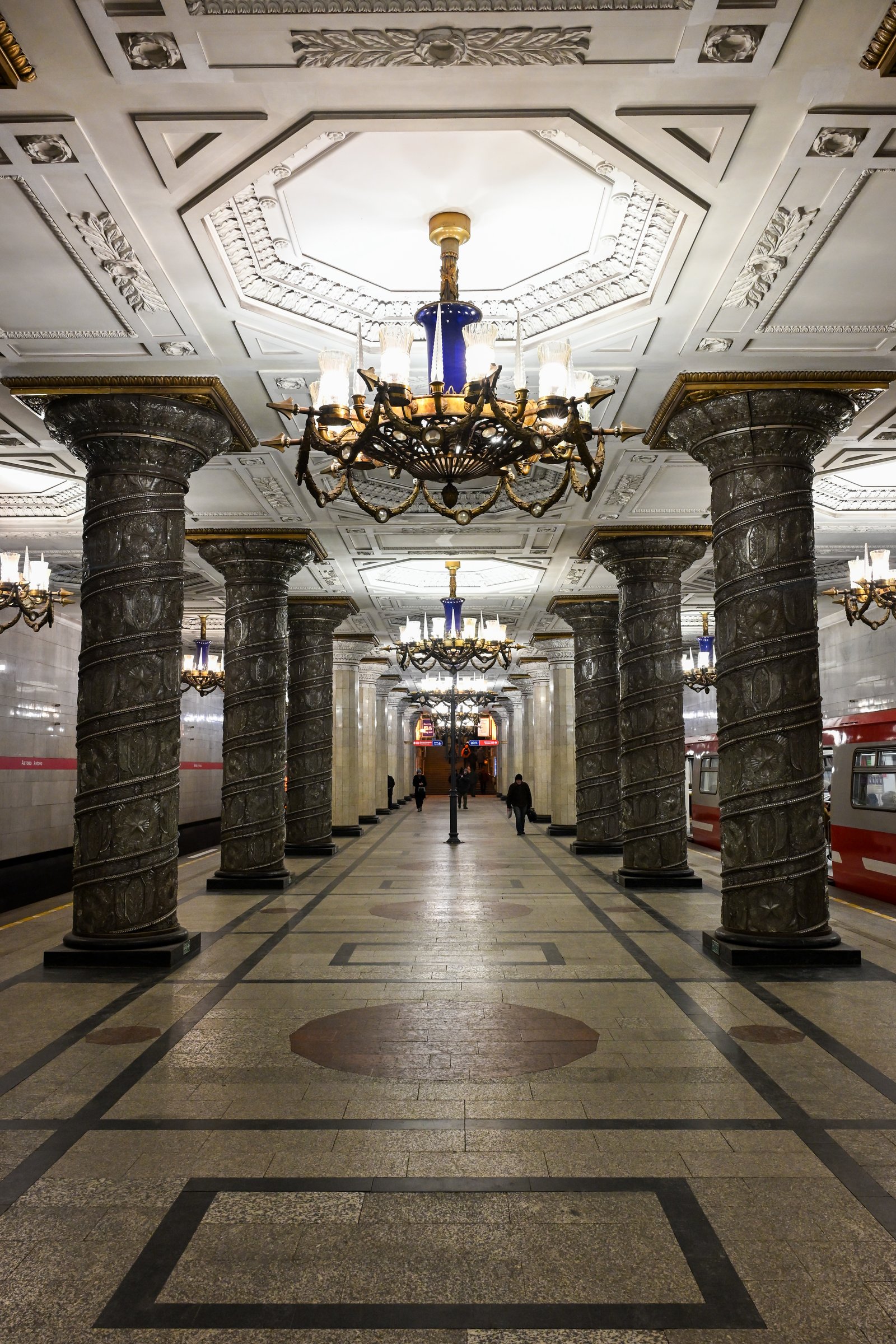
A symmetrical corridor of Avtovo station on the Leningrad Metro displays the monumental architectural language of early Soviet transit design. Massive dark marble columns, intricately carved with classical relief ornamentation, establish a rhythmic colonnade through the station's central hall. An octagonal coffered ceiling with integrated lighting and decorative moldings extends the length of the passage, while brass chandeliers featuring cobalt-blue glass elements hang at regular intervals. The polished floor features geometric inlay patterns in contrasting stone materials. Opened in 1955, Avtovo represents the second wave of Leningrad Metro construction, combining neoclassical elements with Soviet modernist principles. The station's design reflects the post-war emphasis on creating monumental public spaces that conveyed state power and permanence through material and scale. The station continues to serve as a functional example of mid-20th-century Soviet architectural ambitions in underground transit infrastructure.