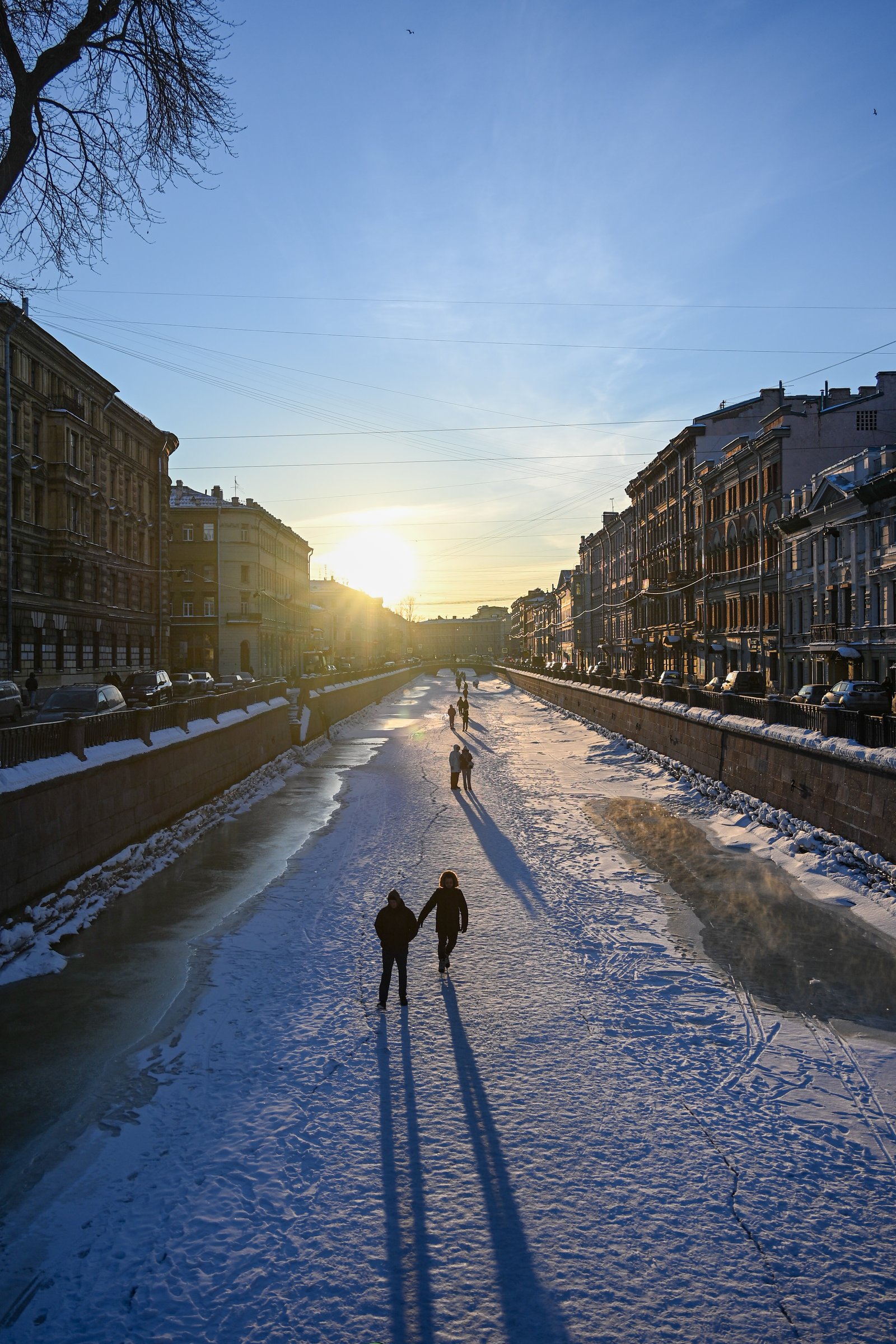
Residents traverse the frozen surface of the Fontanka River during winter months in Saint Petersburg, Russia. The photograph captures a seasonal shift in urban land use, where waterways become temporary pedestrian pathways. Classical 19th-century architecture lines both embankments, their facades illuminated by low-angle sunlight characteristic of high-latitude winter conditions. Multiple figures scattered across the ice surface demonstrate the common practice of winter river crossing in northern cities, where frozen waterways reduce travel distances and provide alternative routes through urban centers. The scene documents both human adaptation to extreme seasonal conditions and the preservation of historical urban infrastructure in one of Europe's northernmost major cities.
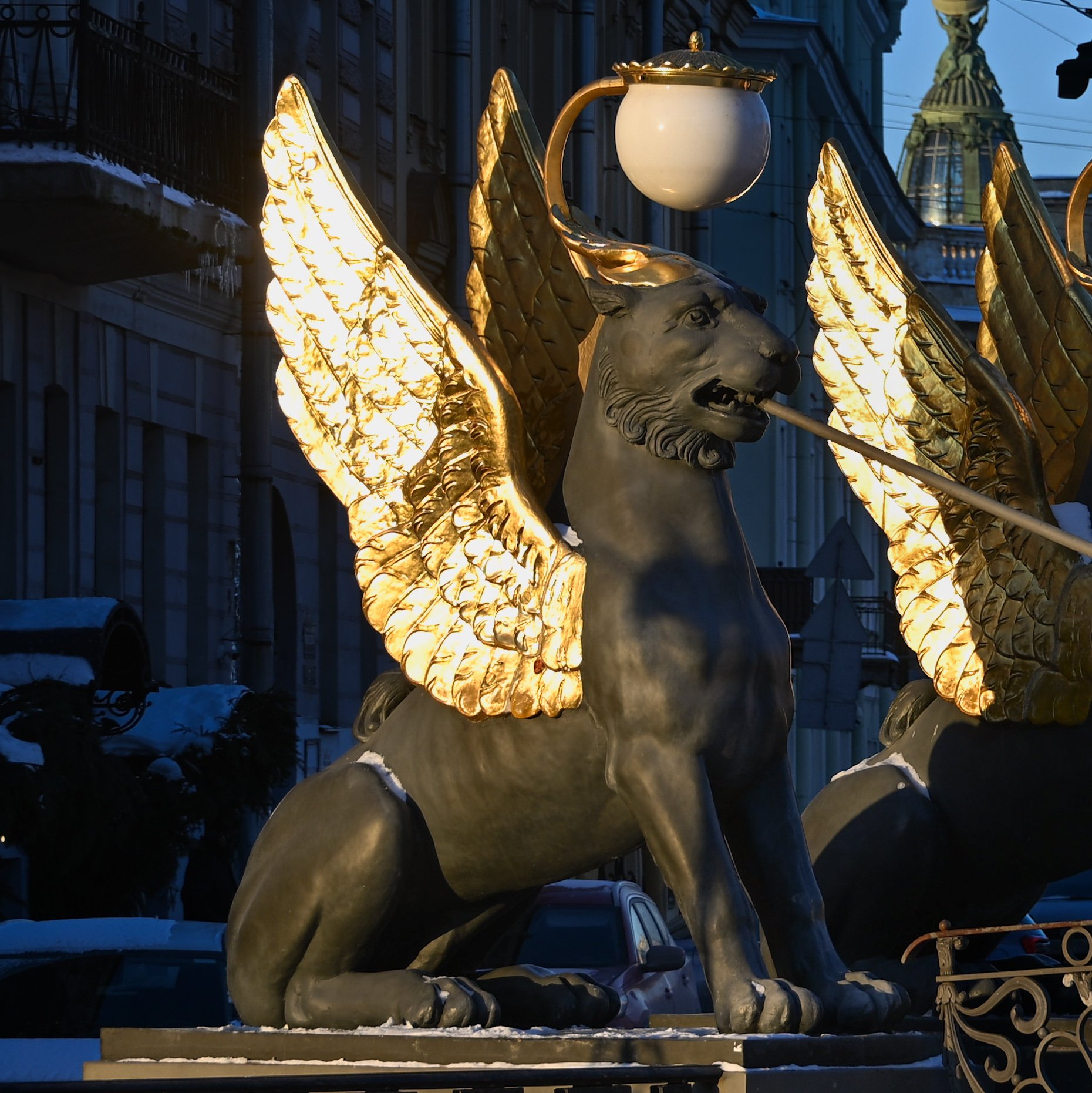
One of four bronze griffins adorning the Bank Bridge spans the Fontanka River with illuminated gilded wings during the polar night. These mythological guardians, cast in the 19th century as architectural ornaments, feature intricate feather detailing highlighted by modern LED lighting that transforms them into luminous sentinels against the darkening sky. The griffin's classical proportions and expressive leonine features reflect the neoclassical aesthetic that defines much of St. Petersburg's architectural heritage. In the background, the spire of the Cathedral of Saints Peter and Paul rises above the surrounding cityscape. The presence of snow and ice on the bridge's surface documents the severe winter conditions of Russia's northwestern climate, where such exposed sculptures face continuous cycles of freeze-thaw weathering while serving as navigational landmarks across the city's intricate canal system.
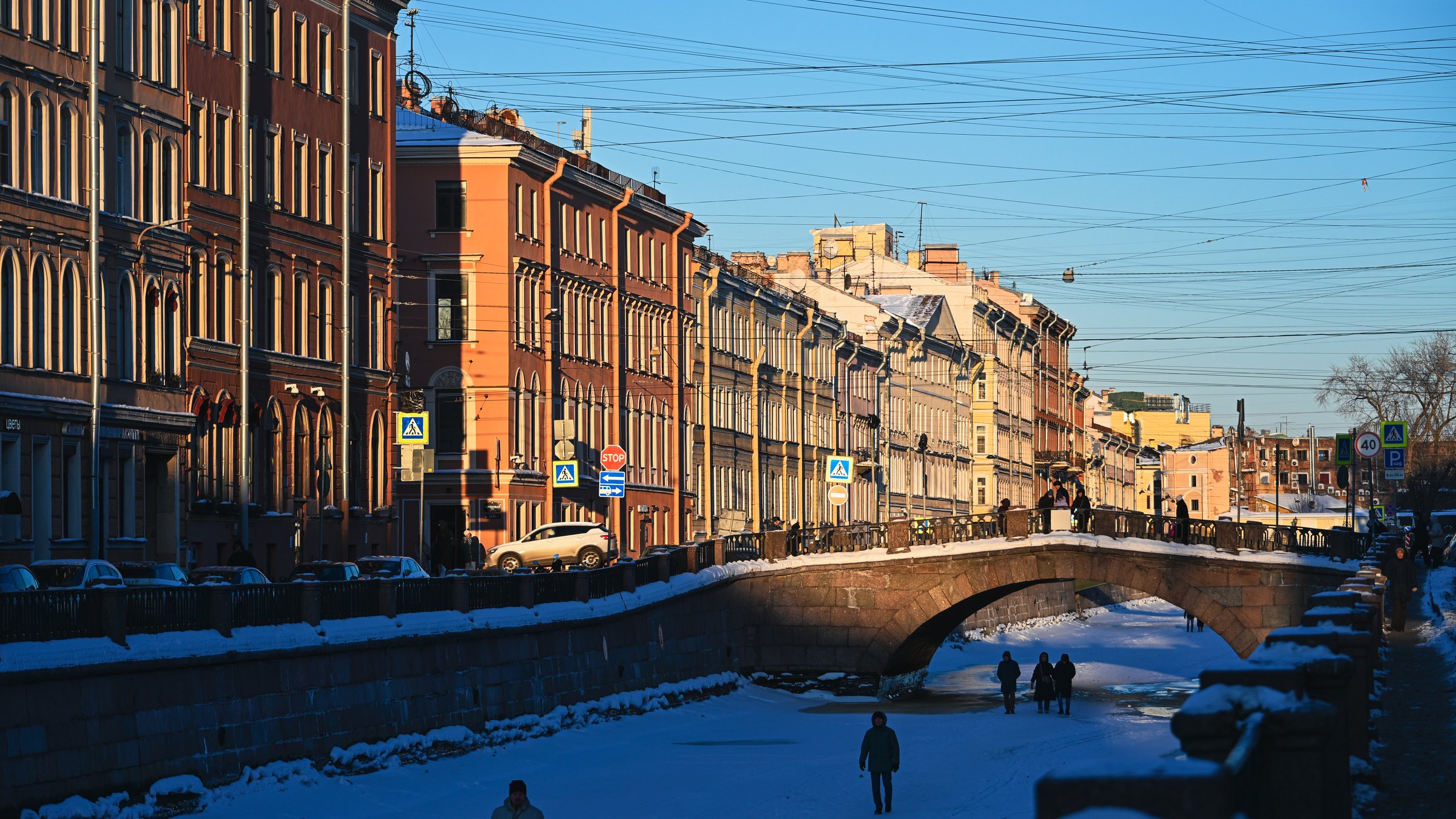
A frozen waterway cuts through the historic center of Russia's former imperial capital, where 18th and 19th-century neoclassical architecture lines the banks. The Fontanka River, one of three major waterways defining St. Petersburg's urban geography, enters a dormant state during the city's harsh winter months, transforming into a pedestrian thoroughfare. Residents traverse the ice while maintaining their daily routines along the embankment above. The architectural ensemble—characterized by ochre, cream, and rust-colored facades with regular fenestration patterns—reflects the city's planned urban development under Catherine the Great. Overhead power lines and contemporary traffic signs document the layering of modern infrastructure across centuries-old urban fabric. The clear winter light creates sharp contrasts between the frozen water surface and the warm-toned masonry, revealing the structural details of the arched bridge and the systematic organization of this UNESCO World Heritage site.
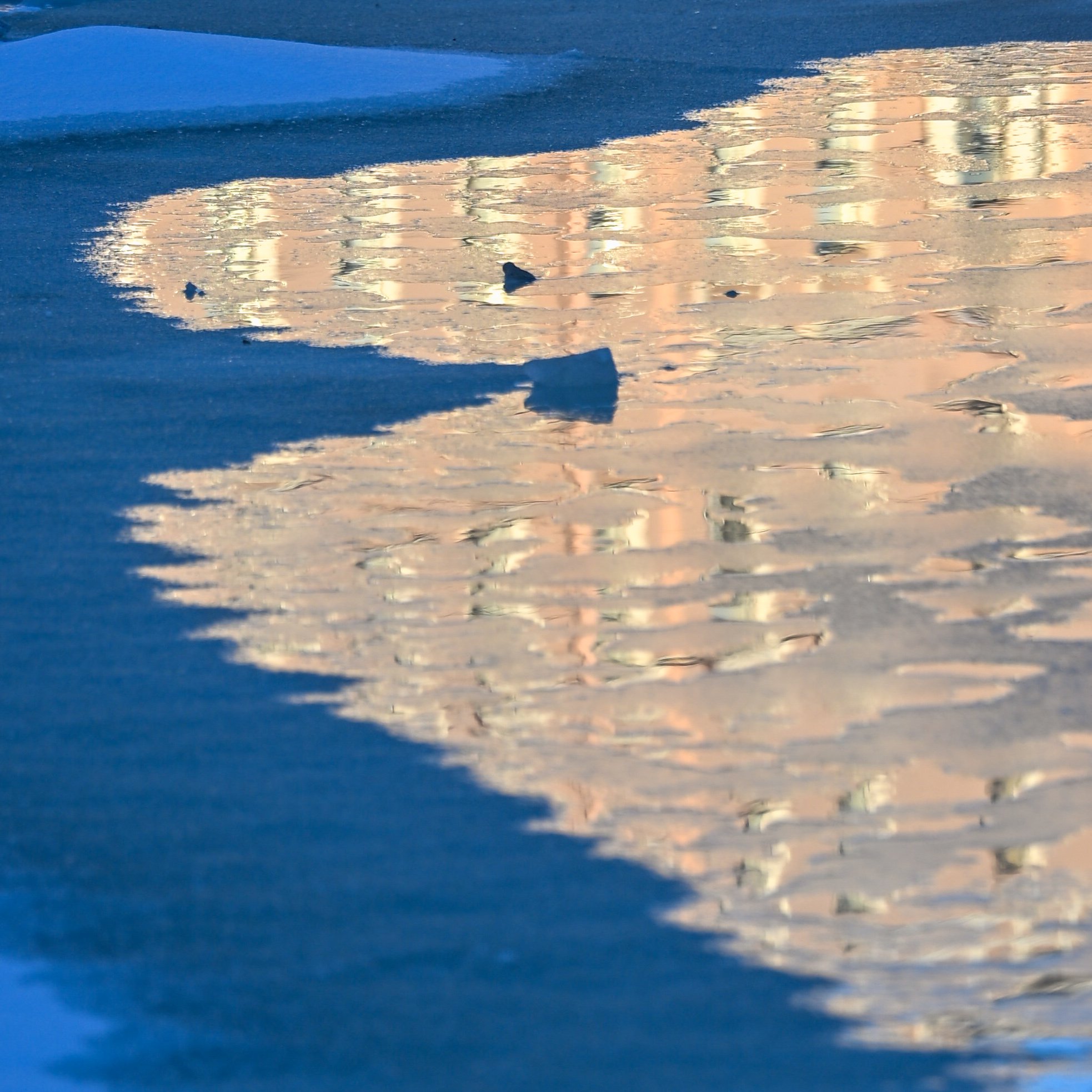
A thin film of water atop the frozen Neva Canal captures the facades of Saint Petersburg's historic architecture during winter. The shallow pool acts as a natural mirror, refracting light across the classical buildings' ochre and cream-colored facades. The image documents the interplay between the city's built environment and seasonal conditions—a common occurrence in Saint Petersburg's winter months when thawing and refreezing create temporary water surfaces on the ice. The distorted reflections reveal the textural qualities of both the water's surface and the architectural details above, while patches of exposed ice and shadow create geometric contrast. This photograph captures a transient moment in the urban landscape, where infrastructure and natural cycles intersect.
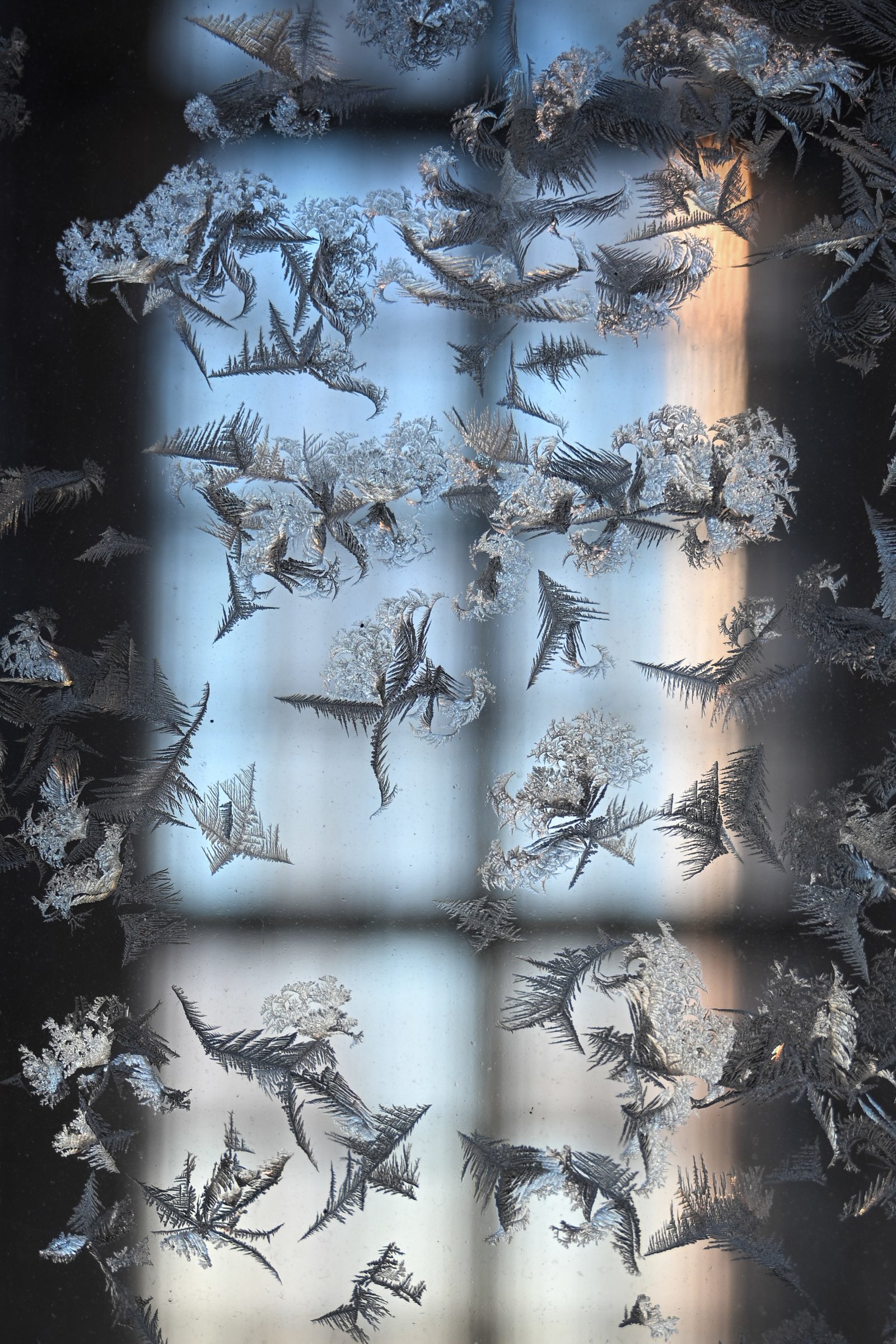
Ice crystals form intricate dendritic patterns across a window pane during sub-zero conditions. The image captures the microscopic process of water vapor deposition, where atmospheric moisture freezes directly into solid ice without passing through a liquid phase. Delicate needle-like structures and feathery formations radiate outward from nucleation points, creating a natural geometric display. The varying crystal density and orientation reflect localized temperature gradients and humidity levels at the glass surface. Warm interior light visible through the central pane contrasts with the crystalline formations at the frame's edges, illustrating the thermal dynamics between indoor and outdoor environments during winter conditions. Such frost patterns serve as visual indicators of atmospheric conditions and provide insight into phase transition processes occurring at the molecular level.
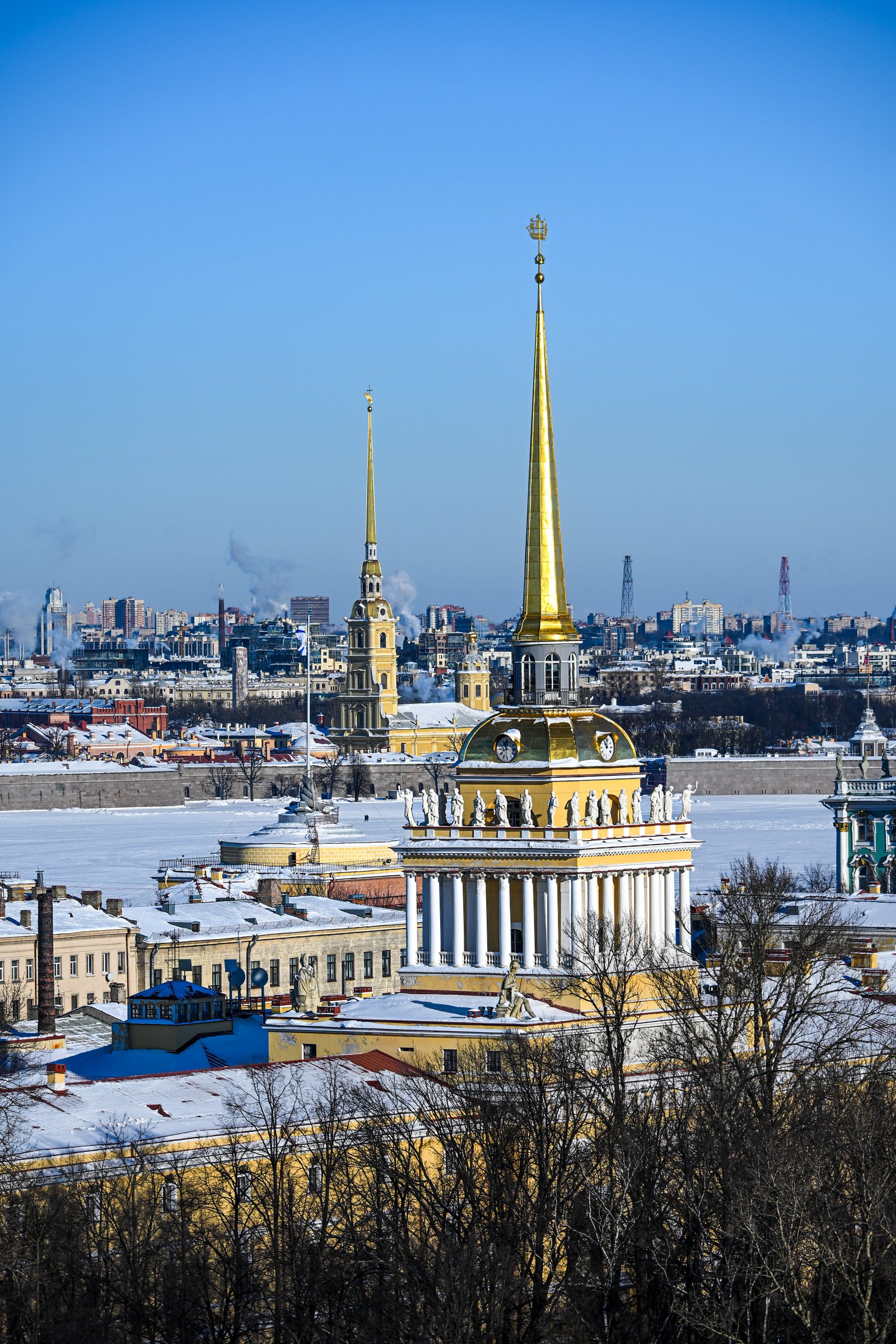
The Admiralty Cathedral stands as a prominent landmark along the Neva River in Saint Petersburg, Russia, its distinctive golden spire rising above the frozen waterway during winter months. The neoclassical structure, characterized by its columned portico and ornate dome, reflects 19th-century Russian imperial architecture and serves as a functioning Orthodox cathedral. In this winter view, the frozen river creates a stark contrast with the urban landscape beyond, while the cathedral's gilded elements catch clear daylight against the pale sky. The composition captures the relationship between this architectural monument and the broader cityscape, illustrating how Saint Petersburg's historical structures remain integrated within the modern metropolitan environment. The frozen Neva, typically navigable during warmer months, emphasizes the seasonal conditions of Russia's northwestern climate.
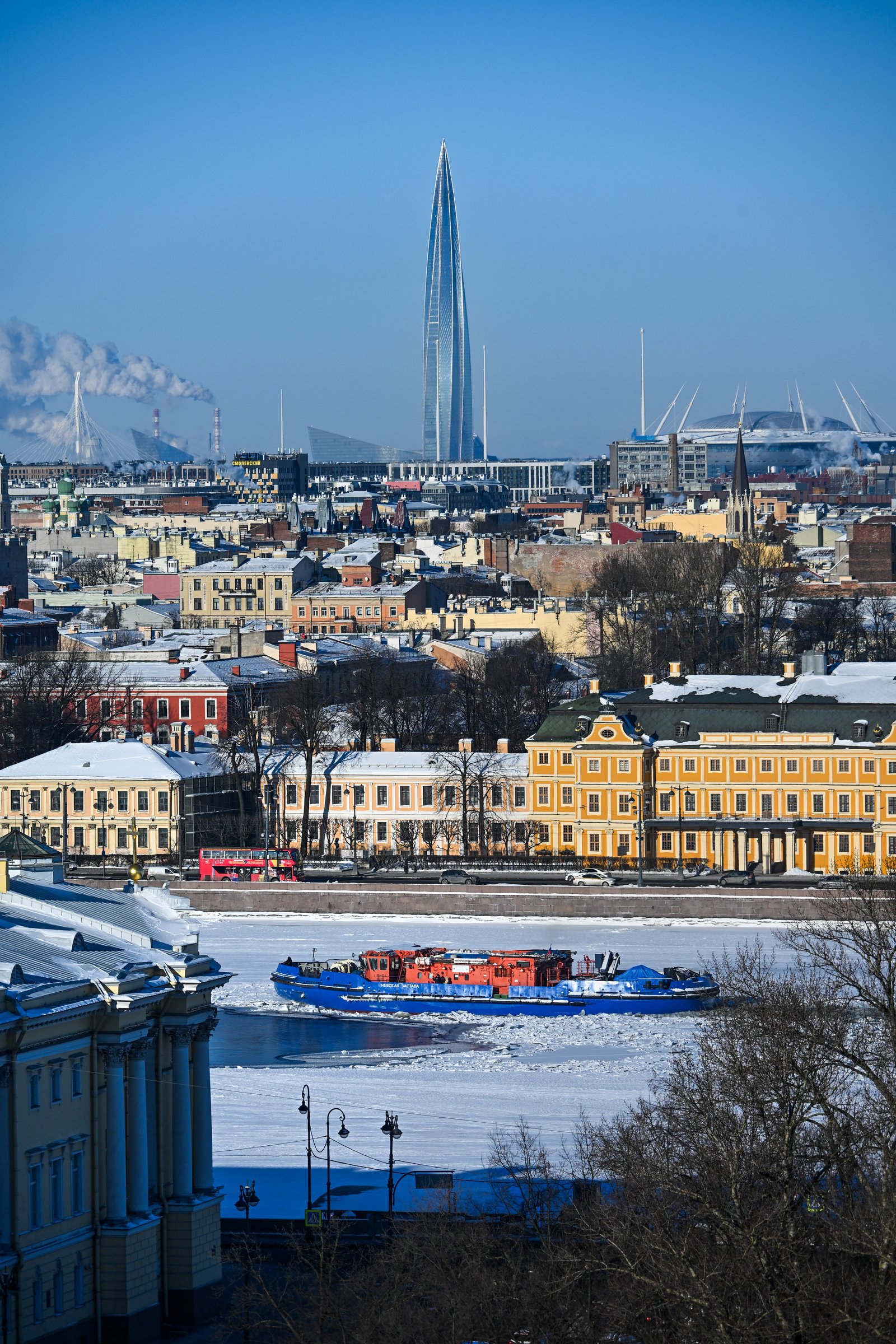
A frozen waterway bisects this urban winter scene in Saint Petersburg, Russia, where contemporary architecture contrasts sharply with 18th-century neoclassical buildings. The Lakhta Center's distinctive spire dominates the skyline, rising 462 meters above the city's historic core. In the foreground, a utility vessel navigates partially frozen waters of the Neva River, while the iconic yellow and ochre facades of the city's administrative buildings line the embankment. The image captures the intersection of Russia's imperial architectural heritage and modern urban development, with the frozen river serving as a natural boundary between old and new. Clear winter conditions and minimal cloud cover provide optimal visibility of the city's layered urban landscape, from the foreground's bare deciduous trees to the distant industrial facilities visible on the horizon. The photograph documents the seasonal transformation of one of Europe's northernmost major cities, where winter conditions significantly alter the urban environment and waterway accessibility.
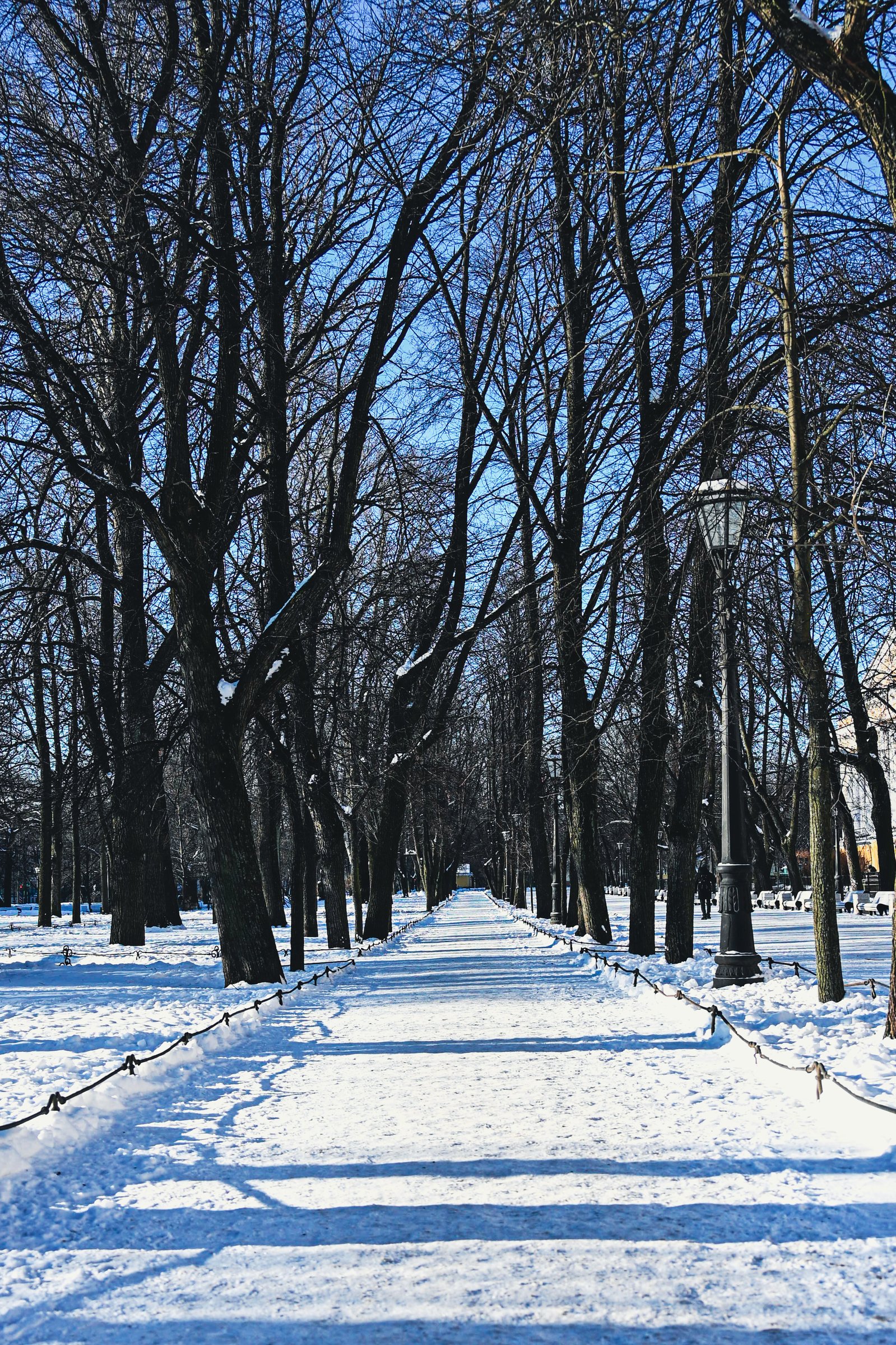
A tree-lined avenue in Saint Petersburg's Alexander Garden demonstrates the stark contrast of a northern winter landscape. Bare deciduous trees create a rigid geometric framework against a clear sky, their dark trunks casting sharp shadows across snow-covered ground. The composition reveals the garden's formal 18th-century design, with trees planted in precise alignment to guide the viewer's perspective toward the distant palace structures visible through the canopy. Rope barriers delineate the pathway, a practical measure to protect dormant vegetation during the season. The interplay of shadow and snow—rendered in shades of blue and white—illustrates how winter transforms cultivated landscapes into studies of line, form, and light. This image captures a moment of seasonal transition in one of Russia's most historically significant imperial gardens, where the absence of foliage exposes the underlying architectural principles of classical garden design.
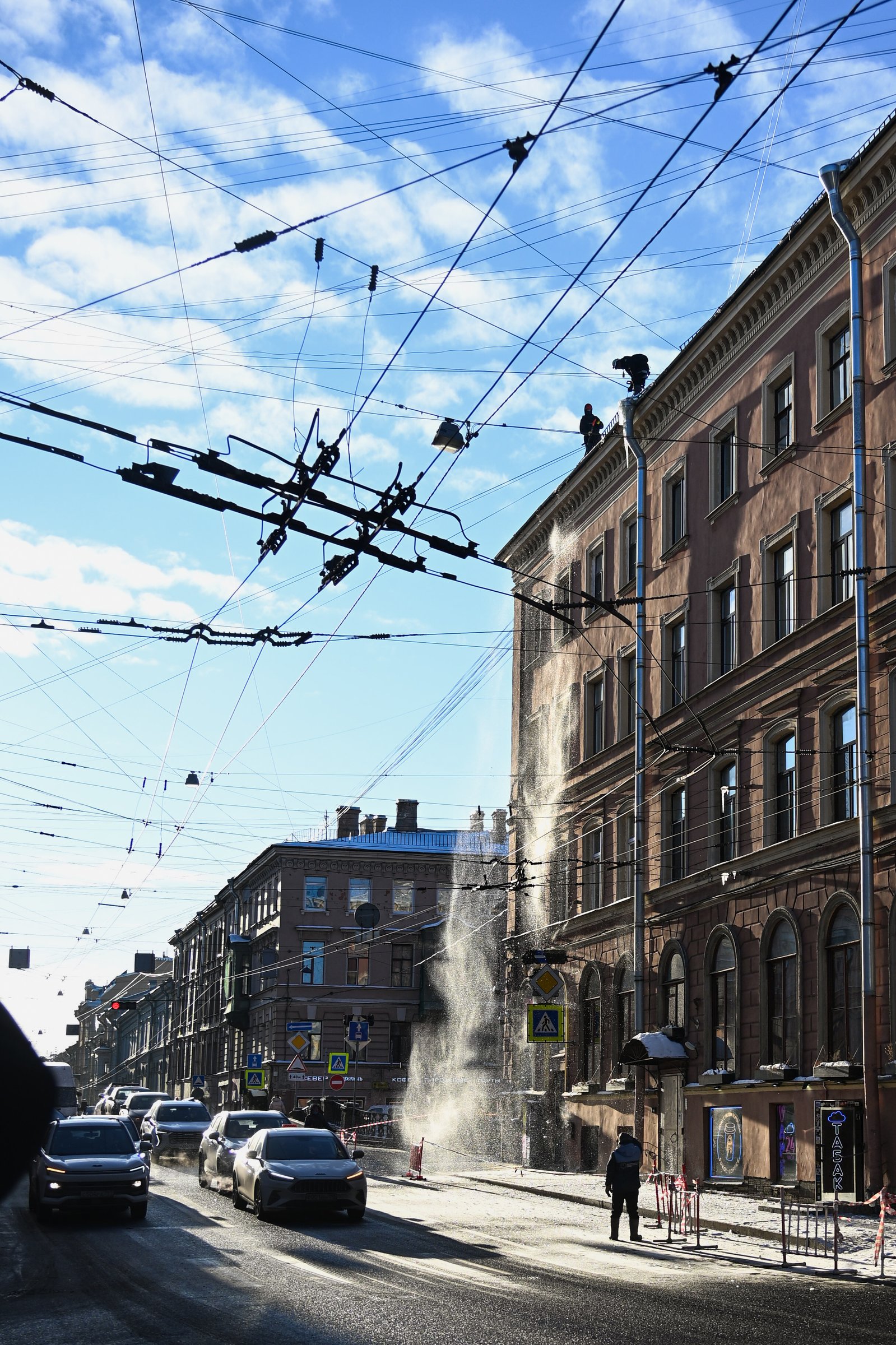
A dense network of overhead electrical lines dominates the skyline above a central Saint Petersburg street, creating a complex geometric pattern against the sky. The tangle of power cables and trolleybus wires—essential infrastructure supporting the city's public transportation system—contrasts sharply with the 19th-century neoclassical architecture lining the street. On the roofline, workers conduct a critical winter maintenance operation, manually dislodging accumulated ice and snow to prevent dangerous falls onto the street below. This composition illustrates the layered challenges of maintaining a major city in a northern climate, where contemporary utility systems and seasonal ice management overlay historical architectural landscapes, revealing both the practical demands of urban infrastructure and the constant human labor required to sustain public safety in heritage districts.
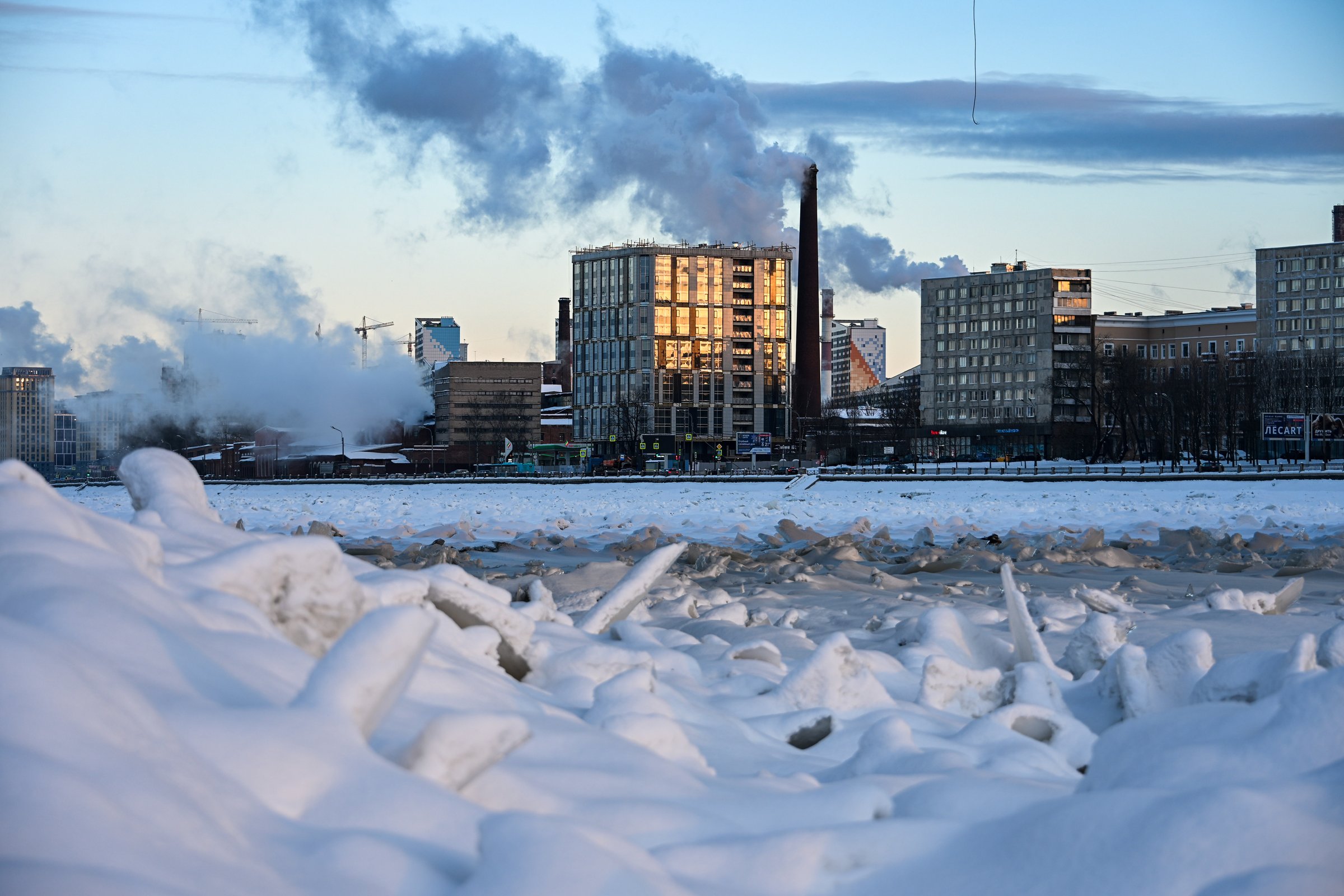
A frozen riverscape frames the industrial and residential architecture of an Eastern European city during early morning hours. The photograph captures the moment when rising sun illuminates the building facades while the frozen water body in the foreground displays characteristic ice formations—jagged shards and pressure ridges created by thermal expansion and contraction cycles typical of winter freeze-thaw conditions. Industrial infrastructure dominates the skyline, including a prominent smokestack releasing vapor into the cold atmosphere, alongside modern residential blocks and construction cranes indicating ongoing urban development. The layered composition—from ice formations in the immediate foreground through the frozen waterway to the distant cityscape—documents the intersection of natural winter processes and urban expansion in a high-latitude climate zone. The timing of the capture during sunrise provides optimal lighting conditions that reveal both the textural details of the ice field and the architectural features of the urban environment, creating a documentary record of seasonal and infrastructural conditions at this specific geographic location.
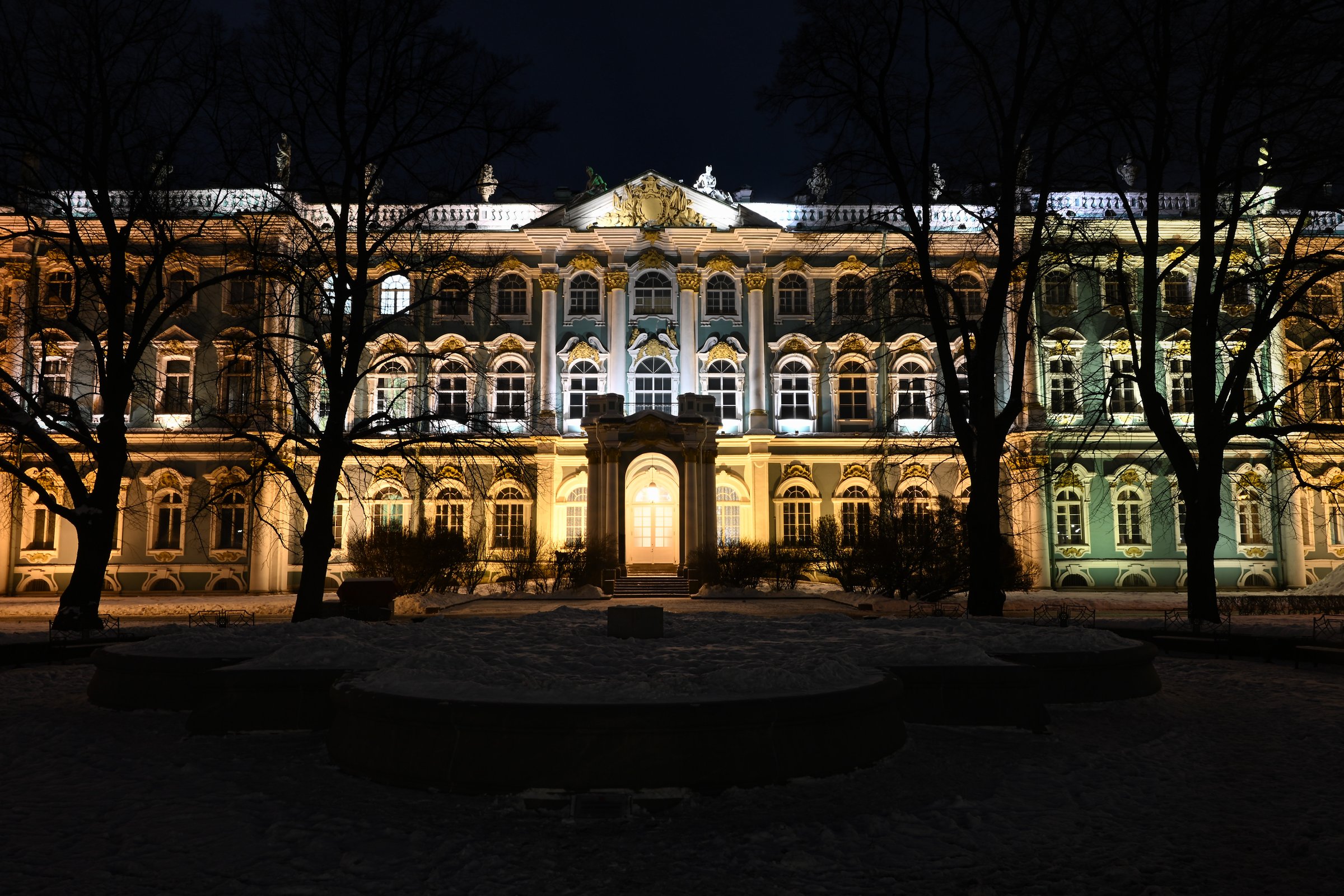
A neoclassical palace complex illuminates the night in Russia's former imperial capital. The multi-story structure displays characteristic 18th-century architectural elements: ornate gilt detailing, symmetrical window arrangements, and a prominent central portico. Bare deciduous trees frame the composition, their silhouettes emphasizing the geometric precision of the façade. The selective lighting—warm tones on the lower levels transitioning to cooler whites on the upper stories—reveals the building's layered architectural vocabulary and highlights the contrast between the ornamental stonework and the austere night sky. This nighttime documentation captures both the structural complexity and the preservation state of one of Europe's most significant historical monuments.
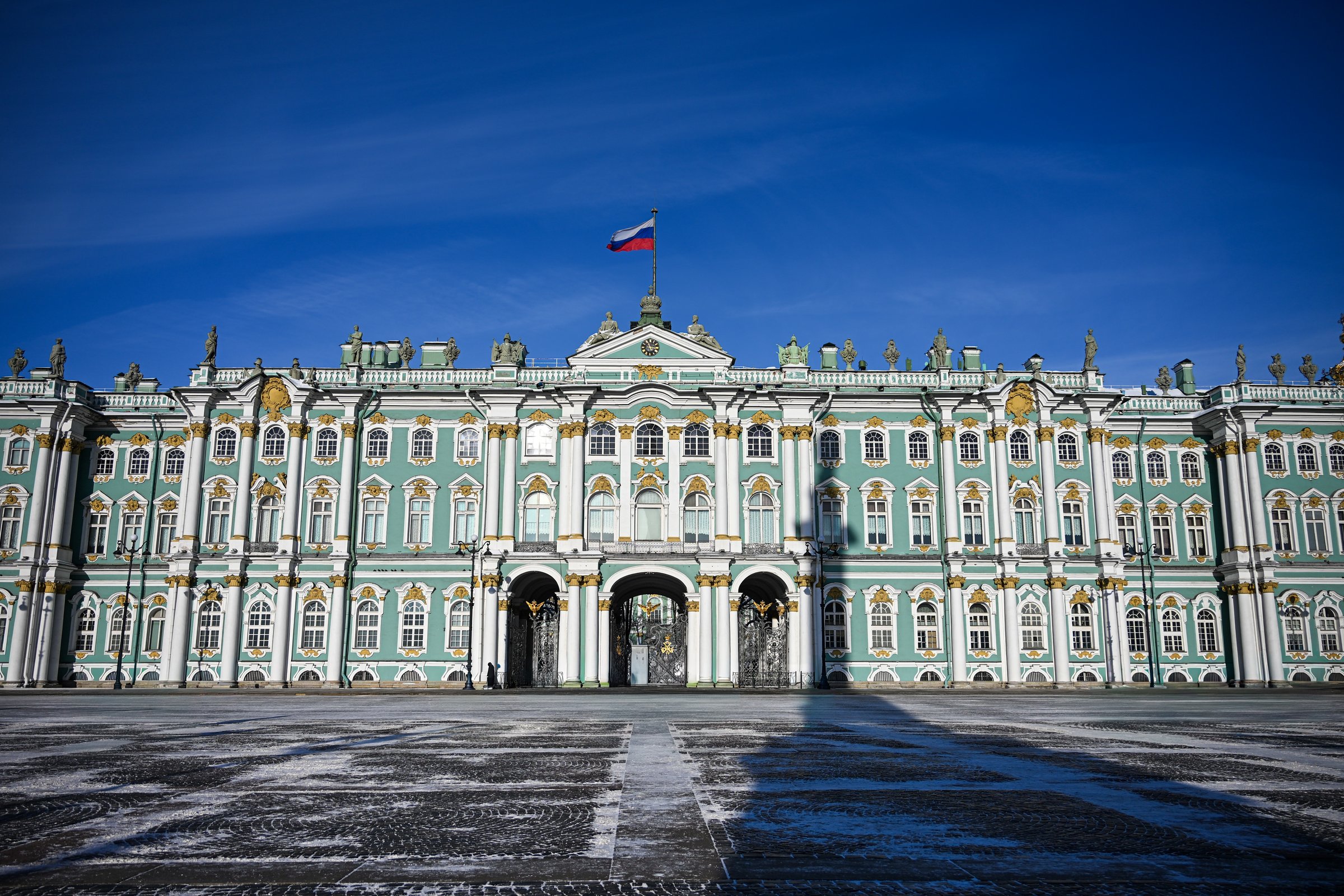
The Winter Palace stands as the former primary residence of Russian emperors and now serves as the main building of the State Hermitage Museum. Constructed between 1754 and 1762 during the reign of Elizabeth of Russia, this Baroque architectural masterpiece exemplifies 18th-century imperial design with its distinctive turquoise and white façade, ornate gold detailing, and symmetrical window arrangements. The structure spans approximately 9,000 rooms and covers an area of 46,500 square meters, making it one of Europe's largest palaces. The photograph captures the palace's Palace Square frontage under clear conditions, with the Russian flag prominently displayed above the central pediment. The geometric patterns visible on the plaza's surface reflect the neoclassical design of the square itself, which was redesigned in the early 19th century. Today, the Winter Palace functions as a museum housing one of the world's most significant art collections, attracting approximately 4 million visitors annually. The building remains a symbol of Russian cultural heritage and imperial history, documenting centuries of the nation's political and artistic development.
XXXIII
CameraGoogle Pixel 9 Pro XLƒƒ/1.7Shutter1/280 sFocal6.9 mmISO22DateFebruary 2026
Port of Helsinki
West terminal 2
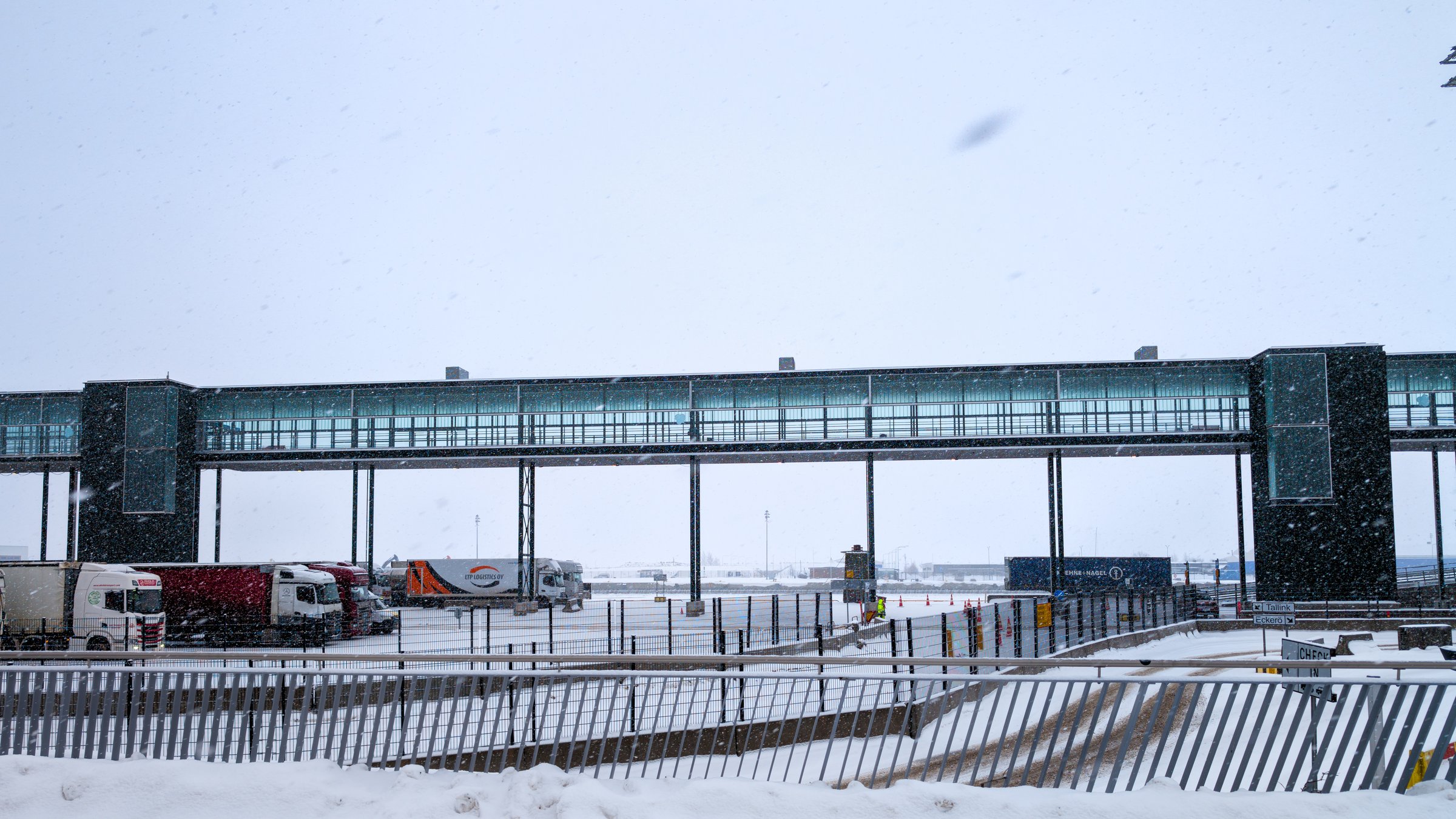
A pedestrian overpass spans the cargo handling area at West terminal 2 of the Port of Helsinki during heavy snowfall. The modernist bridge structure, with its dark metal framework and glass panels, connects terminal facilities across the active port zone where cargo vessels and ground support equipment operate in winter conditions. Snow accumulates on protective fencing in the foreground while shipping containers and port machinery remain visible beneath the overpass. Captured on February 11, 2026, the image documents the operational infrastructure required to maintain port functionality during Nordic winter weather, when snow and sub-zero temperatures present ongoing challenges to maritime logistics and cargo operations. The flat, snow-covered landscape is characteristic of Helsinki's northern maritime setting.
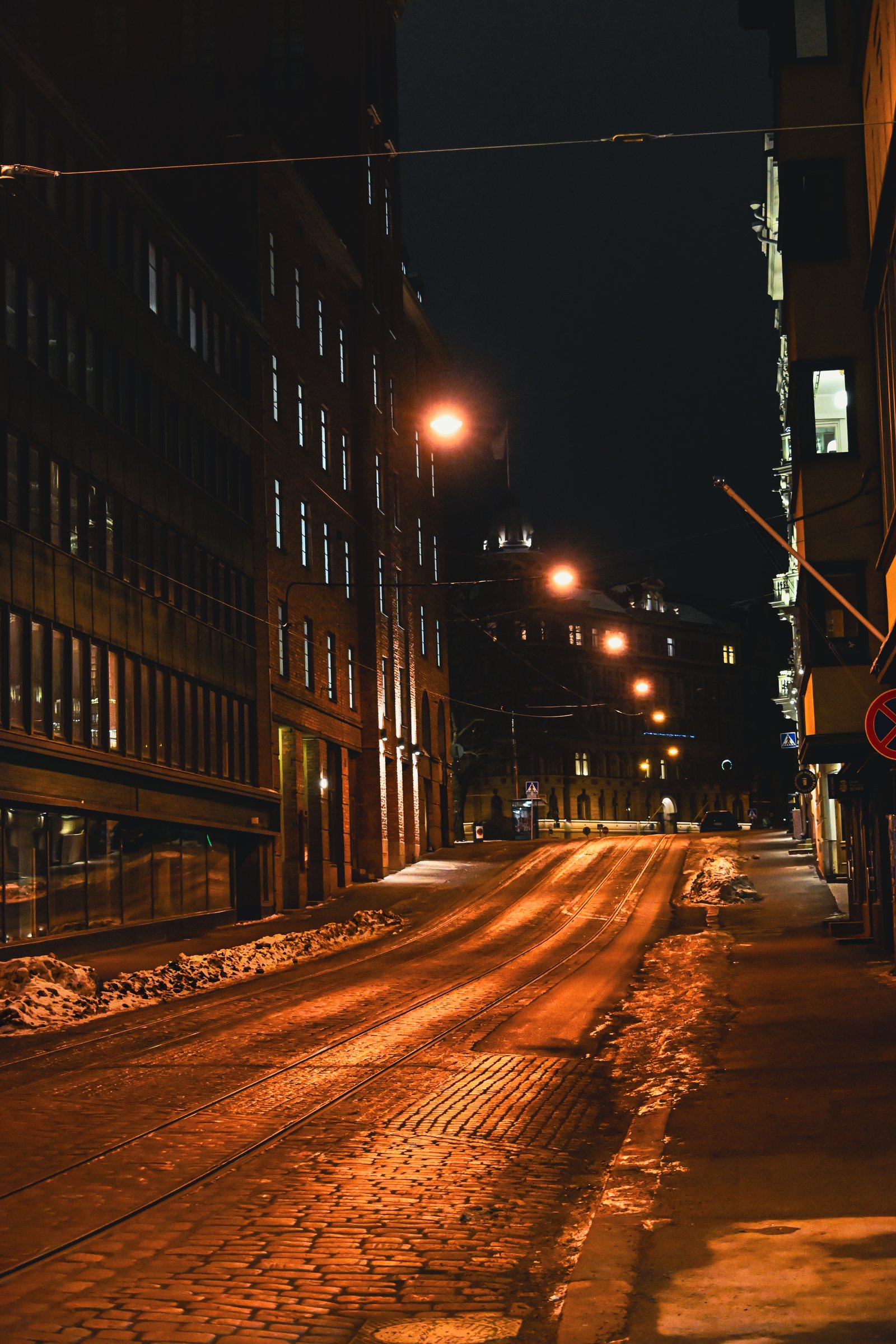
A deserted street in Finland's capital lies frozen under the grip of winter darkness. Sodium vapor lamps cast an amber glow across wet pavement and tramway tracks, their light reflecting off patches of snow and ice that line the urban corridor. The 19th-century stone buildings flanking the street stand silent, their illuminated windows suggesting habitation within, while the absence of pedestrians and vehicles underscores the extreme conditions typical of Helsinki's winter months. The scene captures the Nordic experience of extended darkness—a period when daylight hours contract to mere minutes, forcing urban life into the evening hours. Utility lines crisscross overhead, a reminder of the infrastructure required to sustain human activity in one of Europe's northernmost capitals during the season when temperatures regularly drop below freezing and darkness dominates the daily cycle.
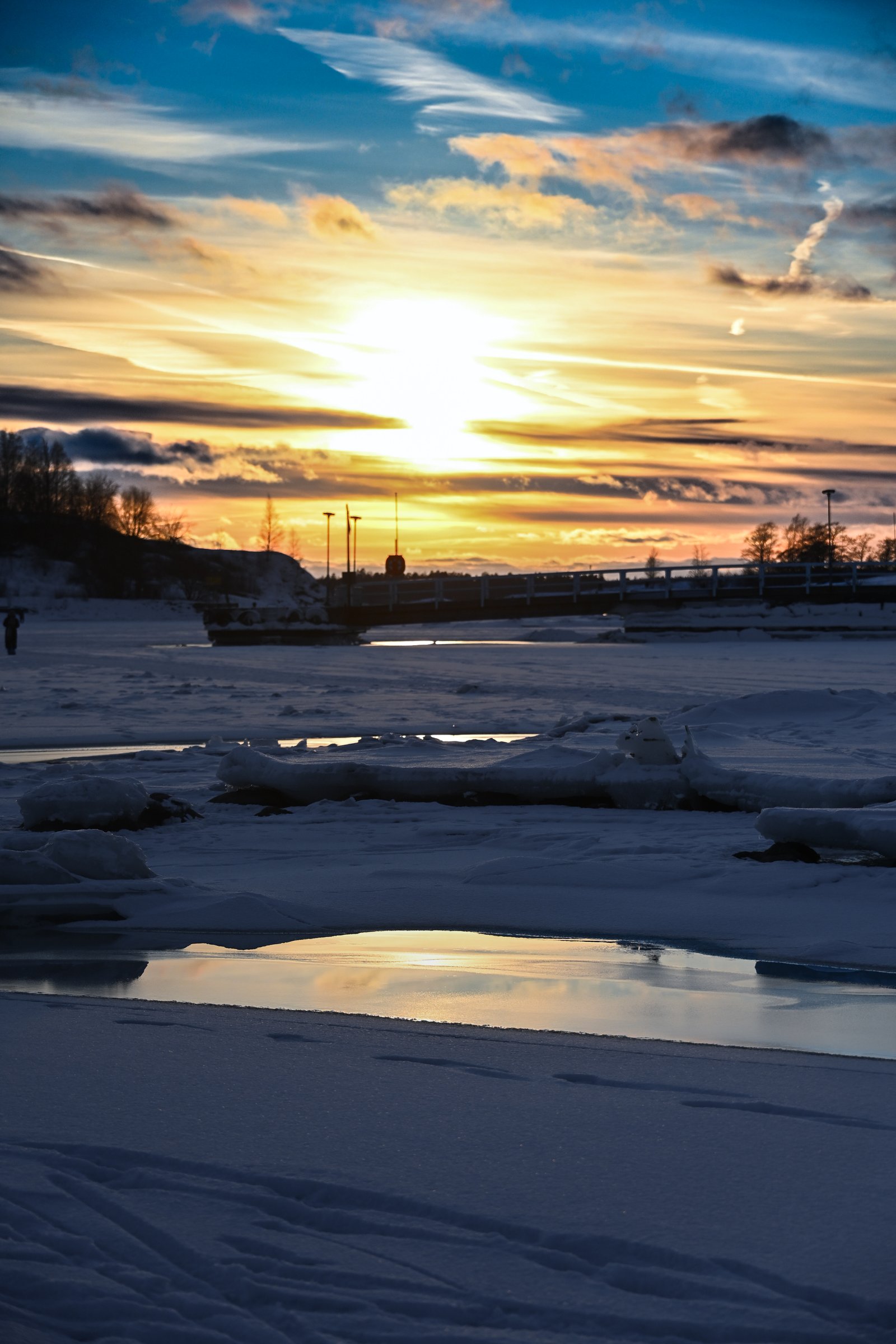
A frozen harbor in Helsinki captures the transition between seasons as the sun dips toward the horizon during the Nordic winter. Fragmented ice sheets scatter across the bay's surface, their jagged edges catching the low-angle light, while partially frozen water reflects the dramatic sky above. A moored vessel sits idle in the harbor, silhouetted against the golden-hour illumination, with the city's infrastructure visible along the distant shoreline. The scene documents the seasonal dynamics of the Baltic region, where maritime activity pauses as water temperatures drop and ice formation alters the landscape. Bare trees line the shore, emphasizing the stark conditions of the Finnish winter season.
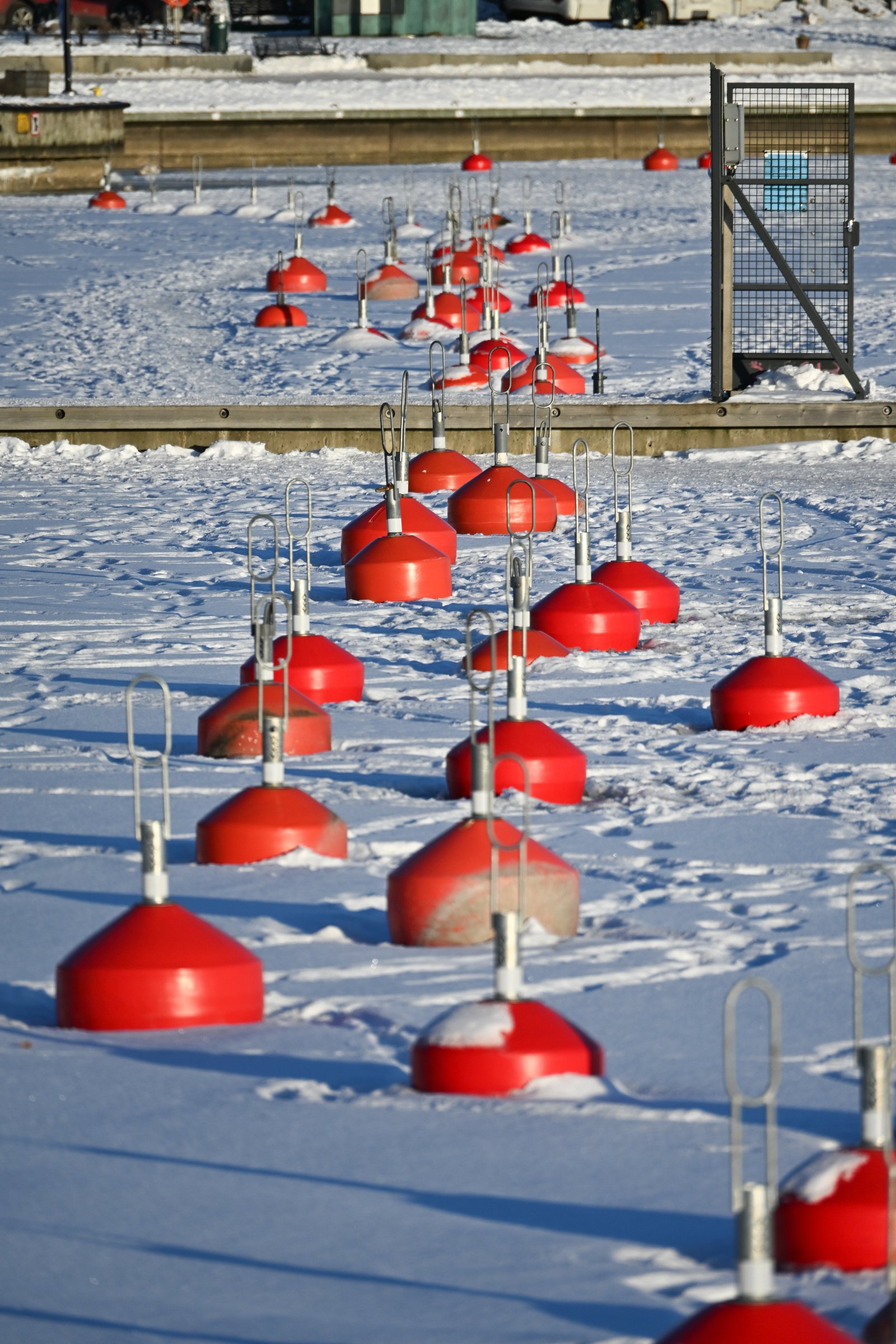
A grid of red buoys sits anchored beneath the ice of Helsinki's frozen harbor, their hemispherical forms resembling oversized radishes planted across the snow-covered surface. Each buoy is tethered to the seabed by metal chains, creating a geometric pattern that extends into the distance. The systematic arrangement reveals the infrastructure required to maintain maritime access in northern European waters when seasonal ice forms. In the background, harbor structures and the concrete embankment define the urban waterfront, while the pristine ice surface documents the depth and duration of the freeze. This image captures the practical engineering solutions developed by Nordic maritime communities to sustain port operations through extended winter conditions—a visual study in human adaptation to extreme seasonal environments.
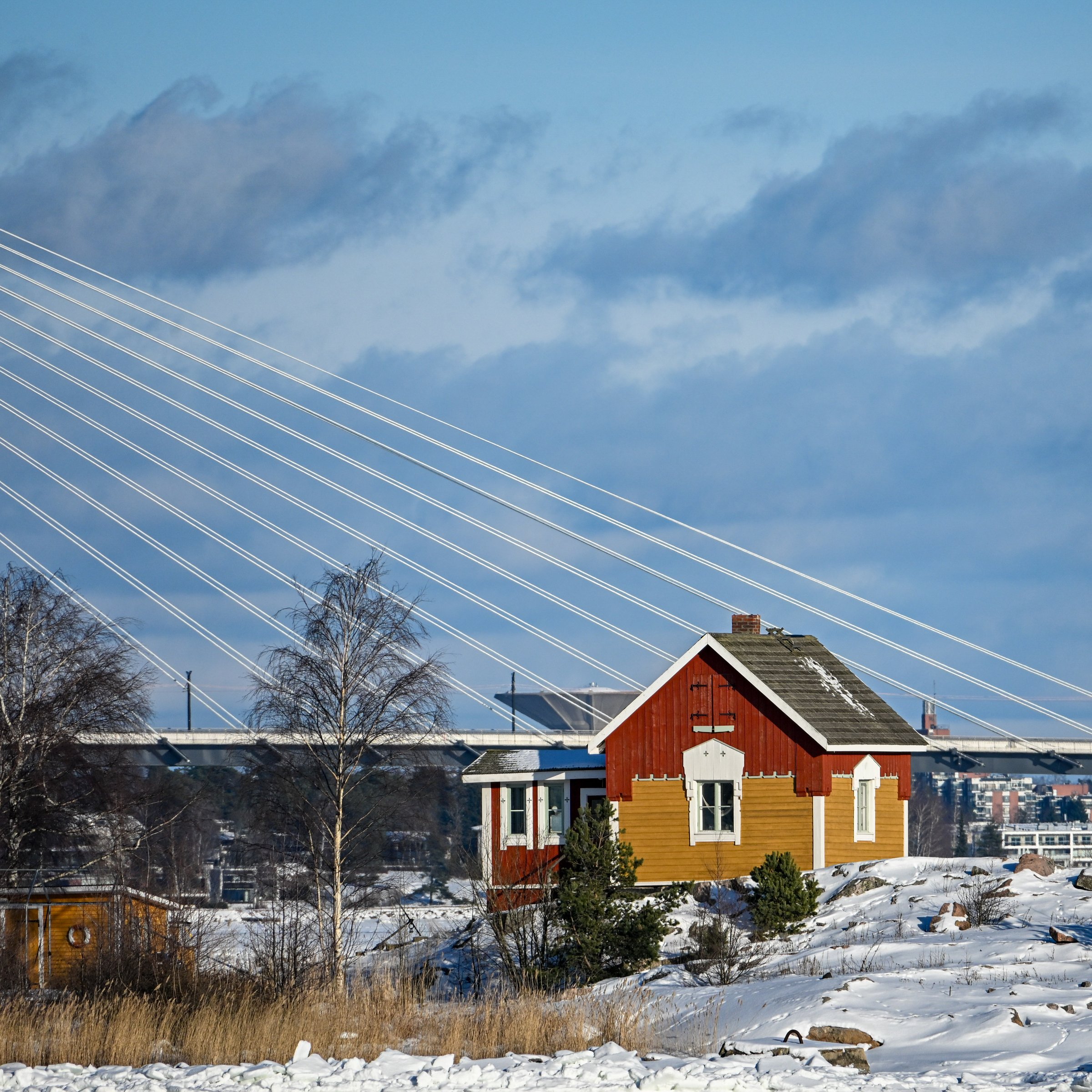
A traditional Nordic cottage sits isolated on the snow-covered shores of Helsinki Bay, its red and yellow wooden facade contrasting sharply against the winter landscape. The structure exemplifies classic Finnish vernacular architecture, with characteristic pitched roof and simple geometric form. In the background, the Jatkasalmi Bridge's cable-stayed design dominates the composition, its parallel suspension cables creating a geometric counterpoint to the organic forms of bare birch trees and frozen shoreline. The image captures the intersection of historical settlement patterns and modern infrastructure development in the Finnish capital's archipelago region. Taken during winter conditions from the Suomenlinna ferry route, the photograph documents the persistence of traditional dwellings within an increasingly urbanized coastal environment. The frozen bay surface and dormant vegetation indicate seasonal conditions typical of the Baltic region's subarctic climate.
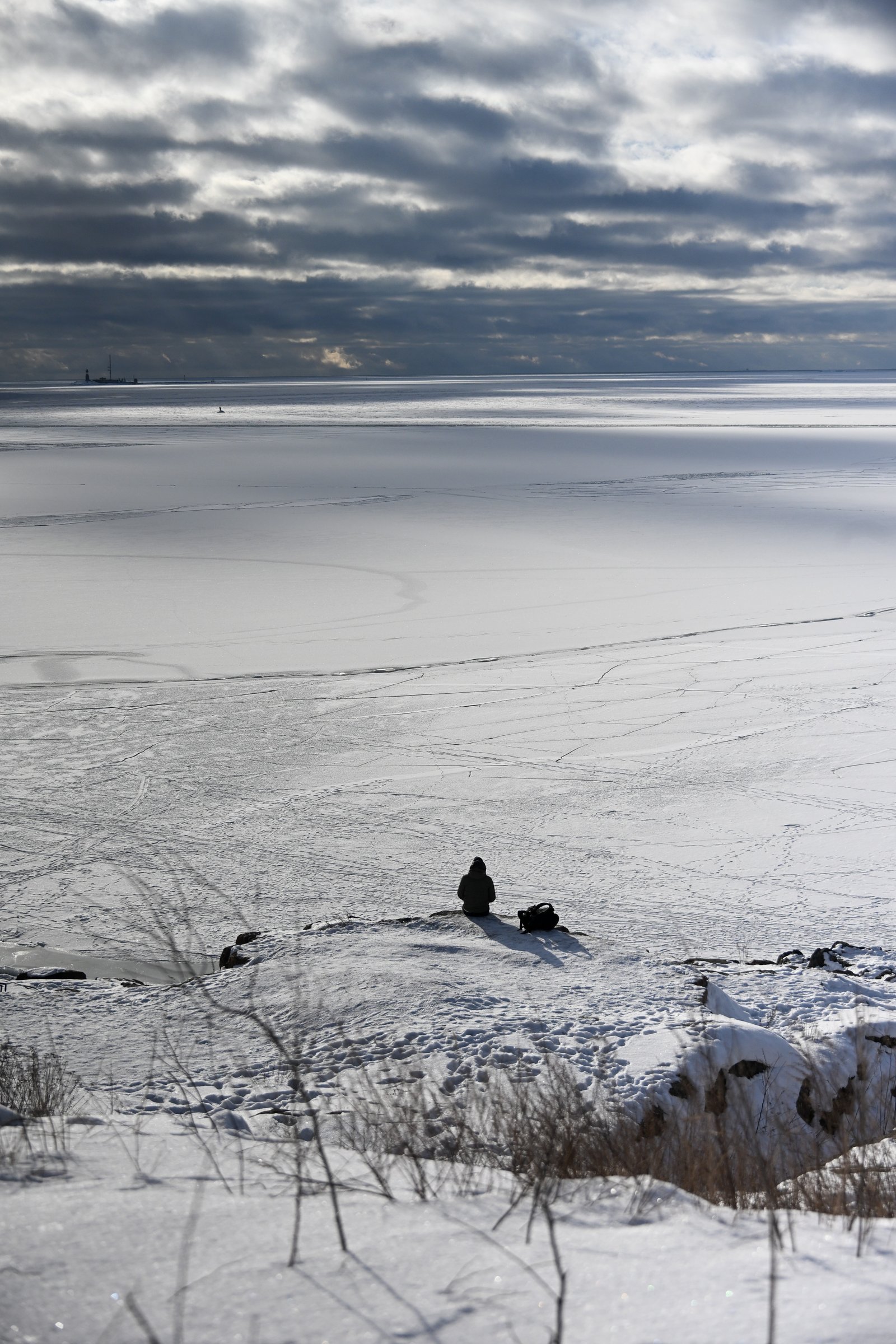
A solitary figure sits on the frozen surface of the Gulf of Finland at Suomenlinna, the UNESCO World Heritage fortress island off the coast of Helsinki. The photograph captures the archipelago during winter's grip, when the Baltic Sea's shallow waters freeze solid enough to support human presence. Linear cracks visible across the ice document the thermal stress of seasonal freeze-thaw cycles, while sparse coastal vegetation in the foreground frames the expansive frozen landscape. In the distance, the silhouettes of the fortress's historic structures and a passing vessel punctuate the horizon beneath a dynamic cloud formation. The image documents a transient seasonal phenomenon—the brief window when land and sea merge into a unified frozen terrain, a characteristic feature of Nordic winter ecology that has shaped human settlement and movement patterns in the region for millennia.
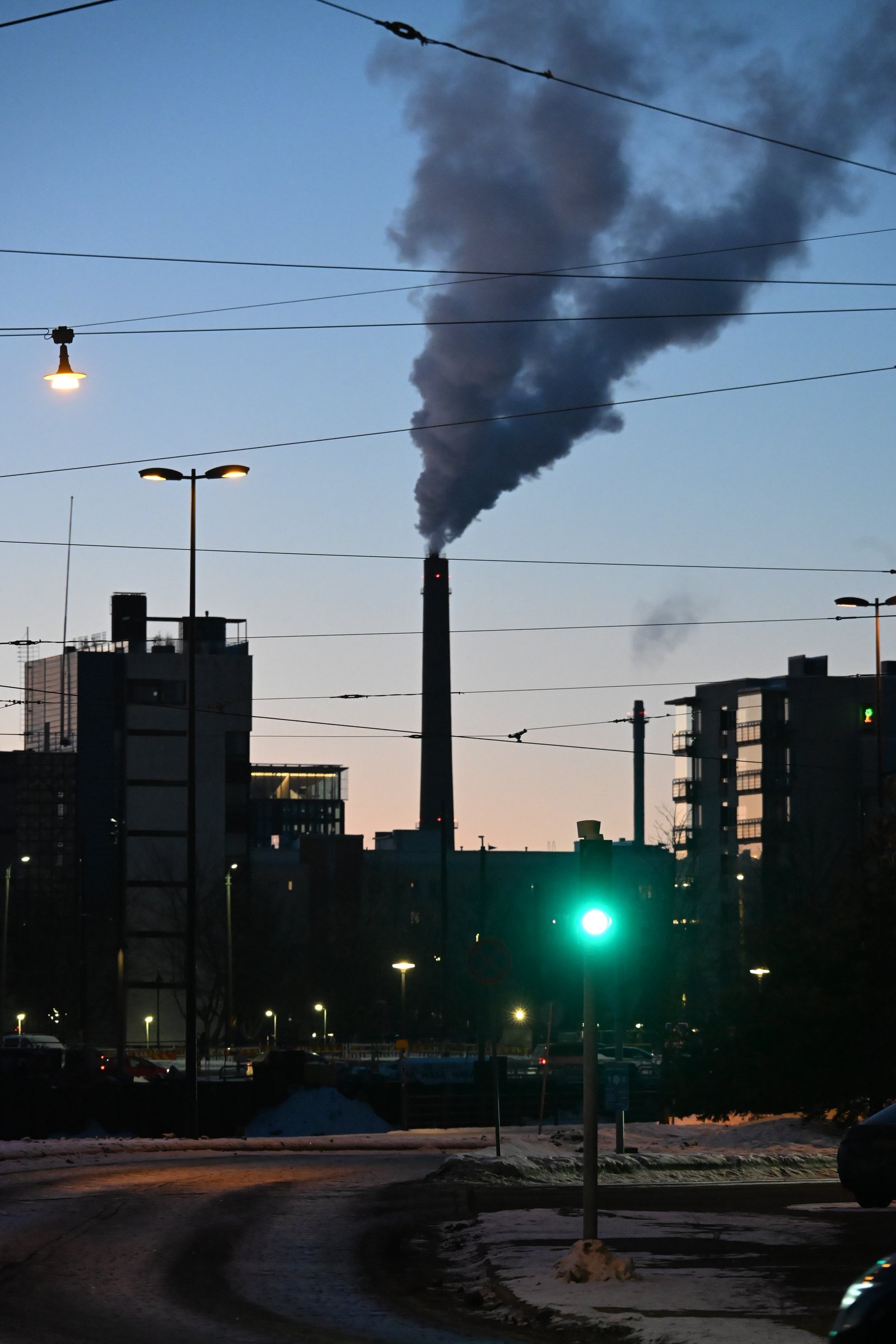
A tall chimney releases a dense plume of dark smoke into the twilight sky above Helsinki's urban landscape. Captured during the transitional hours between day and night, the image documents an industrial facility operating within a densely populated residential area. Street lighting and traffic signals illuminate the foreground, while apartment buildings frame the scene on either side. The contrast between the active emission and the surrounding infrastructure highlights the intersection of industrial activity and urban development in Finland's capital. The photograph serves as a record of air quality and industrial practices in contemporary Nordic cities.
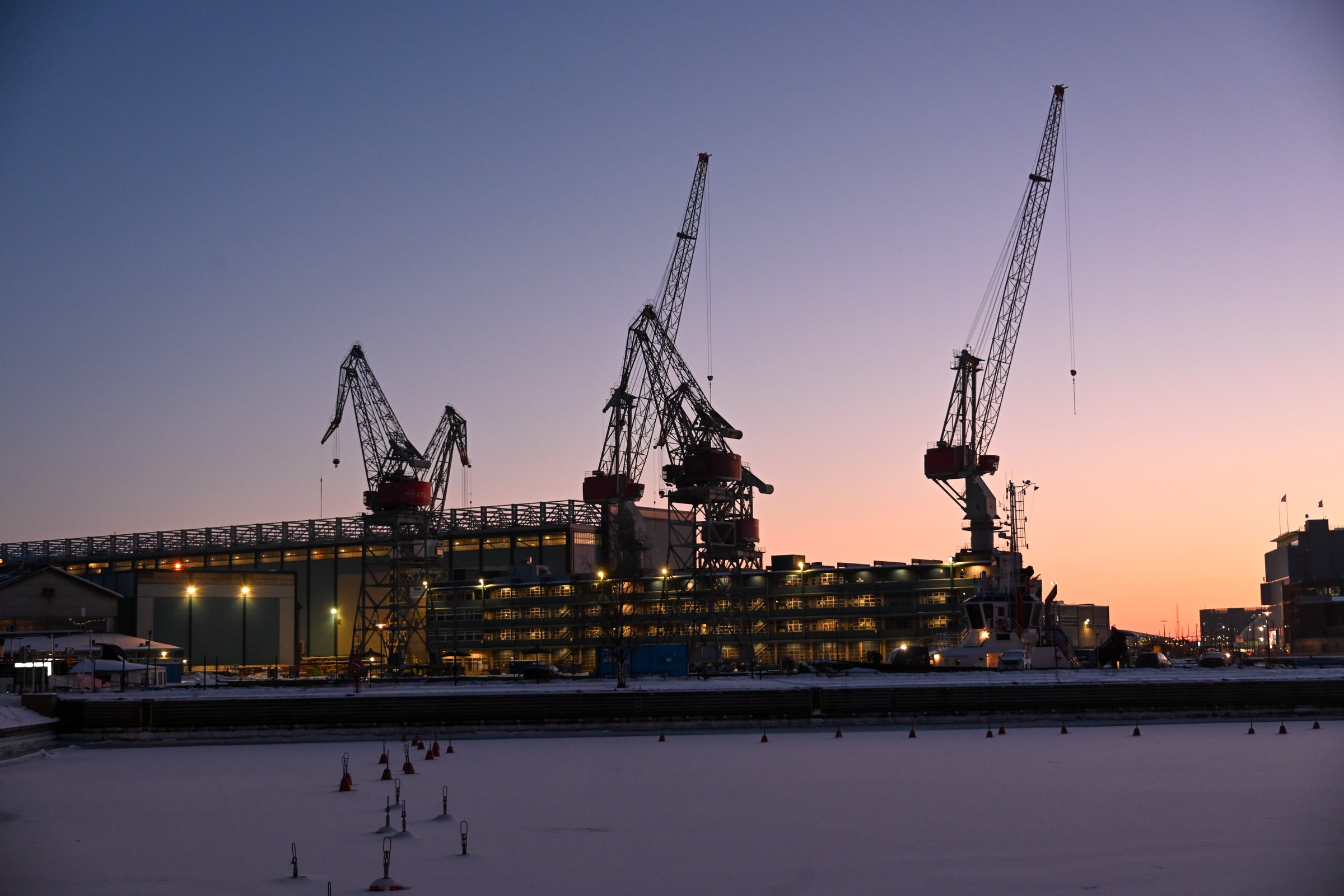
Industrial cargo cranes stand silhouetted against the twilight sky at Helsinki's waterfront, their latticed booms angled skyward in various states of operation. The frozen harbor surface in the foreground bears the geometric pattern of mooring posts and navigation markers, evidence of the Baltic Sea's seasonal freeze. Warm artificial lighting from the adjacent warehouse and dock facilities contrasts with the cool gradient of the evening sky, capturing the transition between day and night operations at one of Northern Europe's major maritime hubs. The scene documents the infrastructure that sustains Finland's shipbuilding and maritime industries during the Nordic winter season.